Pushing software engineering limits with “napkin math”

Pushing software engineering limits with “napkin math”Turbopuffer cofounder Simon Eskildsen on the benefits of longer tenure, using first principles to build durable software – and why founders should be cautious when raising VC money
Hi, this is Gergely with the monthly, free issue of the Pragmatic Engineer Newsletter. In every issue, I cover Big Tech and startups through the lens of senior engineers and engineering leaders. If you’ve been forwarded this email, you can subscribe here. After I recently interviewed Simon Eskildsen, co-founder and CEO of turbopuffer, on the main stage at the AI Engineer’s World Fair, many people at the event told me they found him relatable and inspiring for his choices to stick with one company for close to a decade, his belief in the power of “napkin math” to reveal why products run slowly or cost too much, and for his insight about how too much of VC funding is about ego, not business needs. This article contains the most interesting parts from that conversation; in particular, the concept of “napkin math” – doing quick calculations to get rough answers – as a way to challenge existing systems to improve. The full 55-minute-long video of the discussion at the AI Engineer’s World Fair is available to watch: 
Today, we cover:
Disclaimer: turbopuffer is a season sponsor of the podcast, but as with all our deepdives, this article is independent of podcast sponsorships. 1. Algorithmic programming speedrunA self-taught professional, Simon skipped college to work at Shopify and spent nearly a decade there building a variety of systems. His interest in computers started after initially getting into building websites aged 12. Growing up in Denmark, he dabbled in HTML with tools like Microsoft FrontPage and Adobe’s Dreamweaver. While still a teenager, Simon “hit a wall” by exhausting the Danish-language part of the internet for learning programming, and got into the World of Warcraft MMO game, which helped him acquire English. After discovering the International Olympiad for Informatics (IOI), he decided to enter, despite a very competitive, multi-stage selection process open to all Danish high schools. IOI problems are pretty similar to Leetcode problems: algorithmic challenges that value correctness, speed, and memory usage. Simon cleared the online qualification round and was invited to the Danish Nationals. This was more than a competition: a weekend-long bootcamp to teach participants more advanced programming techniques such as recursion (which Simon already knew), the divide-and-conquer algorithm, and dynamic programming; one of the more tricky concepts to master for algorithmic programming. I tip my hat to the organizers for creating a challenging bootcamp and offering the opportunity for people like Simon, who wasn’t aware of what “NP complete” meant when he entered. He recalls:
Ultimately, Simon claimed one of six spots in the Danish national team, making it through to the regional finals. Aware of how little he knew about programming, Simon doubled down to catch up. He realized that most other participants were better prepared and that he had to do something to survive the next qualifying round. So, he got to work:
As Simon recalled:
The regional finals were even more challenging than the Nationals, and participants struggled to write performant solutions to the problems. Despite putting in the effort, Simon was pretty sure he was out of the competition, and recorded his learnings:
But as it turned out, two months later he was told he had been selected to represent Denmark in the final phase of the competition. Simon continued to push himself out of the comfort zone of web development, using HTML, a bit of PHP, and getting into algorithmic programming. Another decision that would later bear fruit career-wise was starting a blog while at high school – though he didn’t know it at the time. In 2010, Simon launched his English-language blog but posted only one or two articles per year; mostly short ones describing problems he’d solved:
Two posts he published would go on to have an impact on his life. One was about his IOI experience and learnings. The other only came about after he suffered the disaster of fatally dropping his iPhone during his final year in high school. 2. Eight years of infra at ShopifyWith his smartphone dead, Simon was forced to switch to an old-school Nokia “dumb” phone. He wrote a short article about the experience titled Why I’m glad my iPhone broke, which went viral on Hacker News, making it to the front page of the site with many comments. It seems that someone at Shopify, in Canada, read the article and others by him – including the summary of his impressive performance at the International Olympiad for Informatics – as a recruiter from Shopify flew Simon out to interview in Ottawa, Canada, where he was offered a software engineering position at the company. In his new job on the infrastructure team, Simon made notes about things he didn’t understand and read up on new concepts. As he told me:
Working in infrastructure meant solving interesting engineering problems at a time when Shopify was growing 120-140% in load year-on-year; Simon was exposed to problem domains like:
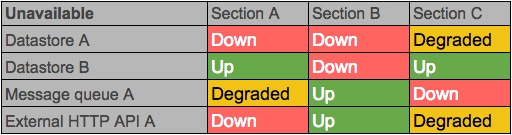
Simon built a framework to simulate networking conditions called toxiproxy. The idea came to him while attempting to write a more thorough, systems-level test to see how Shopify’s application held up during partial outages. He created a matrix of Shopify’s services, and wanted to write a complete test suite for this matrix, to see if the system was resilient enough to handle some parts of the system being down. For example:
As Simon wrote about this problem at the time:
This was the inspiration that led to toxiproxy. As Simon told me on stage:
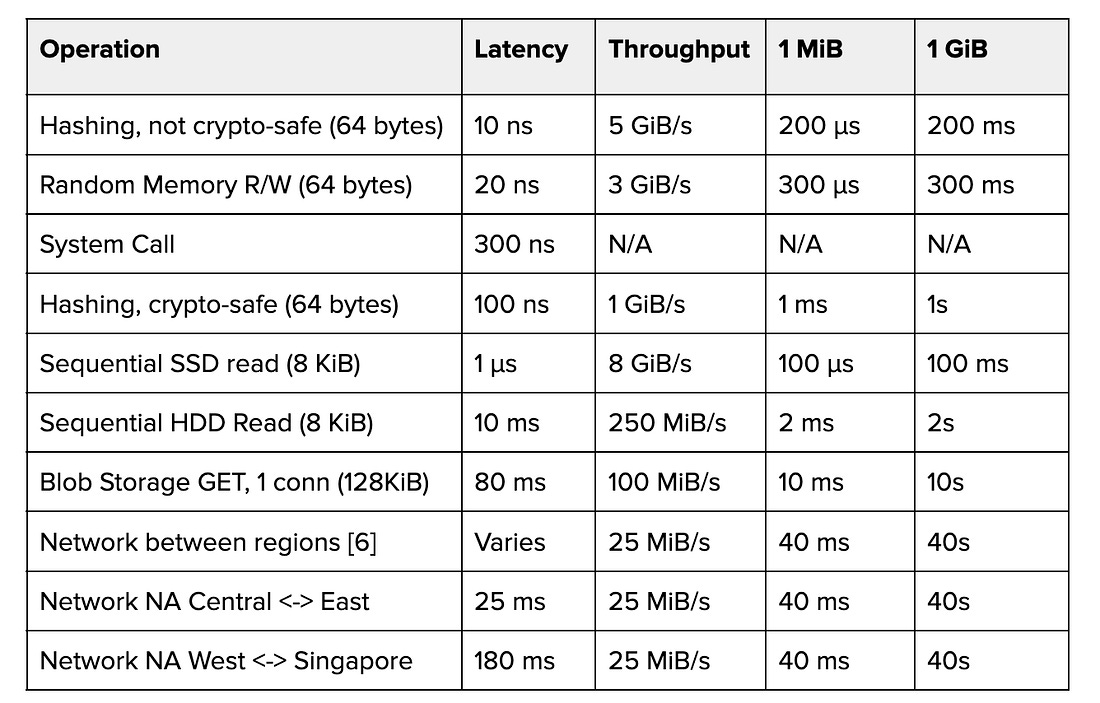
Toxiproxy was open sourced in 2014, and apparently still runs in Shopify’s CI system 12 years later, to Simon’s knowledge! The biggest benefit of a long tenure at a company was learning to write software that ages well. Simon told me that this was the lesson that made it so worthwhile, and how often the simple solution someone put together in a week or two outlasted the big, multi-team RFC-driven solutions. That was a lesson he still uses today. 3. “Napkin math” as a superpowerWhile at Shopify, Simon became interested in figuring out the theoretical limits of certain computer operations. For example, how much bandwidth does DRAM have for memory transfer? How long does a round-trip operation to AWS S3 take, and how much does it cost? What does a gigabyte of memory cost? He sought the actual numbers, wrote a script to collect them, and created a table with the data:
Simon started to memorize key numbers with flash cards. He wanted to be able to instantly recall all important numbers. As he told me:
Napkin math enabled him to challenge design decisions based on benchmarks that had issues. As he told me:
Simon went even deeper into “napkin math” after leaving Shopify. He investigated whether MySQL’s maximum transactions per second is equivalent to fsyncs per second (the number of file writes per second a system can handle). He discovered that MySQL can handle more writes than the operating system could sync to the file, which was a surprise:
Simon started to investigate, and learned that MySQL does grouping of transactions (not doing an fsync for every write), and it also does smart merging of multiple fsync operations that would be processed in parallel, effectively doing a “group commit” to further improve performance. This is a learning he’d later use: grouping writes together on top of S3, to reduce latency and improve cost. Personally, I find it amazing how much you can learn with some measurements and by asking questions about how a system achieves results that go against what the “napkin math” suggested should be its limit! 4. Origins of turbopuffer“Napkin math” also played a part in the creation of turbopuffer. Simon told me that three things had to combine for the project to come to life. 1. Search was a difficult project at Shopify. Building search was one of Simon’s final projects at the company, and he did not have a good time with it. He used a popular database vendor but struggled to have it perform napkin math. The query plans were not exposed easily by the database, so he could not figure out what was missing and why it wasn’t performing the napkin math without reading massive amounts of source code. Also, the search infra was difficult to operate. 2. Napkin math became a surprisingly efficient reasoning tool. As a toolkit, napkin math gave Simon a way to reason about what could be achievable with a machine, if utilized perfectly. 3. His friends’ startups needed fast search badly because of AI. In early 2023, Simon helped a few friends with infra at their startups, many of whom had the same problem: LLM context windows were very small (4-8 KB), and they needed to fill them with the right parts of documents, but this demanded very fast search. One startup budgeted that their new search vendor would cost $30K/month, while the existing infra bill was only $5K/month! For a bootstrapped Canadian company, the cost was too high, so they didn’t ship the AI feature. Simon could not stop thinking about why search was so expensive, and why it didn’t line up with what the “napkin math” predicted the cost should be. Eventually, he laid out a basic architecture to make it fast and cheap:
Driven by curiosity about how that could work, he set out to build it. As he told me:
What about performance? Simon:
5. A new product without VC funding & Cursor as customer no.1I first heard of turbopuffer last year, when I interviewed Cursor cofounder Sualeh Asif about how they built the AI coding harness. From our previously published Cursor deepdive:
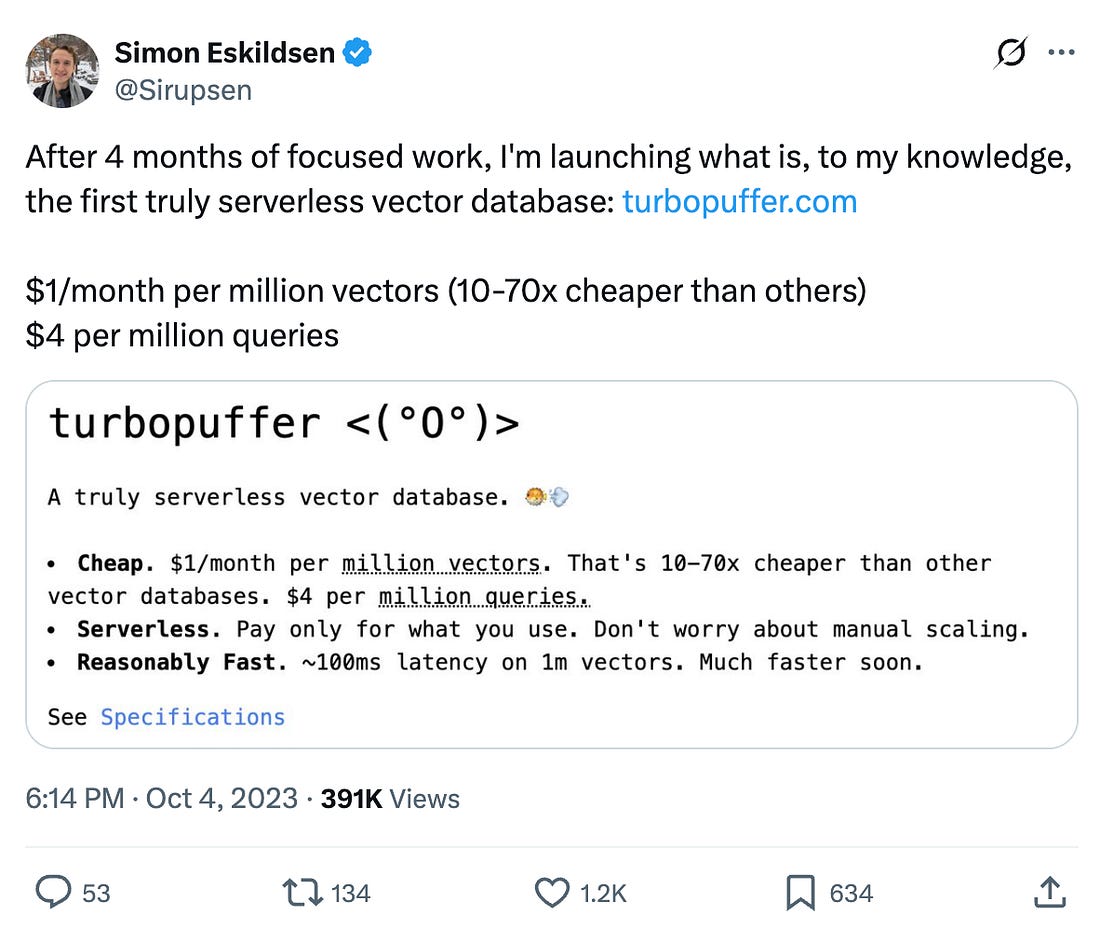
So, how did a billion-dollar startup come to bet on a tiny, unproven infra product with zero customers? There were a few factors: First, Cursor was not yet a billion-dollar company in the fall of 2023, but a relatively fresh startup. The company raised $8M in seed funding in the same month. In 2024, the company was valued at $400M, and then its valuation surged to $29.3B. It was sold to SpaceX for $60B this year. Secondly, it involved a tweet Simon posted after having had enough of building all summer, and wanting to test the waters. As he told me:
So, he put out this confident-sounding tweet:
Simon had the confidence to launch his product because he knew it was rock-solid and scalable:
Cursor reached out. The company was an eight-person team at the time, fresh from seed funding and growing fast, but with a search problem that they were looking to partner with a startup on. Simon recounts:
Simon knew nothing about B2B sales at that point, and was not trying to “sell” anything to Cursor. He exchanged a few emails with the Cursor team about their use case of searching many small local codebases. He wanted to help Cursor with the unit economics, while also proving that turbopuffer works. So, he hopped on a flight from Canada to San Francisco, arrived at Cursor’s office and got down to debugging their database provider:
It was around when turbopuffer’s other cofounder, Justine Li, joined that the work with Cursor kicked off. Simon describes Justine as the best engineer he ever worked with at Shopify, and together, they made more performance optimizations. Cursor migrated their local code-base search over to this brand new product. Simon promised to reduce Cursor’s bill by 95%, and delivered – thanks to napkin math! Cursor was spending around $80K/month on indexing and search; with turbopuffer in place, this dropped to $4K/month. Simon was confident about making this prediction thanks to napkin math! He did the calculations based on the fundamentals; only counting resource usage that Cursor was using, and not taking a margin for turbopuffer’s operating cost at the time. 6. Reasons to raise venture capitalAfter securing Cursor as the first customer, Simon was not convinced that turbopuffer should raise VC money. He explained his thinking:
A few months later, turbopuffer ended up raising a total of $700K, just to be able to hire two engineers until the end of the year on real salaries. Simon found that most VCs did not take them seriously for wanting to raise too little money, and assumed this signified a lack of ambition! Two years later, with less than $1M in initial funding raised, turbopuffer crossed $100M in annual run rate. So, there evidently was ambition! Since our conversation, Simon has reflected on the topic of VC capital and built a mental model of six reasons that justify raising external funding: Reason #1: Research and development. This is what turbopuffer raised for: they needed the money to hire two more engineers until the end of the year, in order to build out more of the platform. Then, they would either get more customers and generate enough revenue to not need funding, or shut down the project if it failed to gain traction. Reason #2: Growth. When you’ve built something and want to tell the world about it, often, you have to spend money on doing that. Reason #3: Massaging founders’ egos. Simon:
Reason #4: Employee rewards. A startup is a long journey, and everyone wants to work with the best people. But there are necessarily few of these folks, so you want to reward the standout ones by raising money so that employees can sell their shares. This was why, in December 2025, turbopuffer raised a round where they let employees sell some of their equity: it meant they would not have to wait for a future financial event like an IPO. Reason #5: Strategic partnerships. It might be the case that raising from a VC whose network of connections is key to your business succeeding, or that taking funding from a strategic investor gives you access to their platform or services. Reason #6: Mergers & acquisitions (M&A). Purchase another company with the funding in order to expand the business. Simon encourages founders to be honest about why they raise capital funding – and to watch out if the reason is egocentric! TakeawaysWatch the full interview here. It’s inspiring to see how far it’s possible to get with “napkin math” and by understanding the bottom layers. It didn’t sit right with Simon to make decisions about vendors based on hastily written benchmarks that might measure the wrong thing. By understanding the constraints of data transfer latency and storage cost, he found a way to estimate the theoretical lower bounds of the system. This helped lead to more informed design decisions at Shopify, and showed him there was an opportunity to build a faster, cheaper search product than the status quo. Getting “lucky” in business requires a lot of skill, and in-person greatly helps with first impressions. Turbopuffer’s first customer being Cursor sounds almost too good to be true. But the account from Cursor cofounder Sualeh Asif – and now from Simon – reveals the ingredients in more detail:
It’s always helpful to be aware of the dynamic of venture funding – some of which are rarely mentioned. Simon knew investors expect returns and growth on timelines which they set. Raising money is helpful in many situations, but problems arise from egotistical reasoning, and Simon believes too many founders prioritize them – knowingly or not. You’re on the free list for The Pragmatic Engineer. For the full experience, become a paying subscriber. Many readers expense this newsletter within their company’s training/learning/development budget. If you have such a budget, here’s an email you could send to your manager. This post is public, so feel free to share and forward it. If you enjoyed this post, you might enjoy my book, The Software Engineer's Guidebook: navigating senior, tech lead, staff and principal positions at tech companies and startups.
|





Comments