Ben Affleck is Human

Box of Amazing: A weekly essay on human capability in the age of AI. By Rahim Hirji, author of SuperSkills (out July 2026). Pre-order the book at superskillsbook.com My book SuperSkills: The Seven Human Skills for the Age of AI is available at all good bookstores, through superskillsbook.com or on AmazonI work with organisations and leadership teams on SuperSkills, human capability, and AI-era decision-making through speeches, workshops, keynotes and advisory work. In person or virtual. UK, Europe, global. → Book a discovery call | → Explore: thesuperskills.com
Friends, I remember watching the clip and had forgotten it within an hour, in the way we scroll and no longer remember Ben Affleck, across a table from Joe Rogan, talking about artificial intelligence and the film business. He was calm in a way that did not fit the argument I was used to hearing, with no panic in it and no salesmanship either. I nodded at something, closed the tab, and got on with my day. It left no mark. A few weeks later there was a headline. Netflix had bought an AI company, and the name on it was his. The deal was reported to be worth as much as six hundred million dollars. This time I stopped, and not for the money. I stopped because the man I had filed under sceptic had spent three years building the very thing he seemed so unbothered by. I felt confused and conflicted in my head. So I went back, and I stayed longer than I meant to. He has two Academy Awards. He wrote Good Will Hunting with Matt Damon when they were young and unknown, and they won for the screenplay, with Robin Williams saying their lines. Years later he directed Argo, the true story of a CIA officer slipping six Americans out of Tehran during the hostage crisis, and it won Best Picture. The Academy gave the film its highest prize and did not nominate Affleck for directing it, as though the film had directed itself. I have no interest in the tabloid version of him, the marriages and the paparazzi and whatever the magazines are selling this month. The other one is more useful. He is proven, he is unusually articulate, and when he talks about this he has done the reading. Whatever you make of him, and I will tell you what I make of him, a great many people know his face. I think that matters. Netflix released a video when it announced the deal. Affleck is in it, describing his company, InterPositive, as a way to take out the logistical, difficult, technical work that gets in the way of making things: the wire you paint off a stunt, the shot you missed and go back for, the lighting you reshape after the fact. His phrase for what this gives you is the one that pulled me all the way in. “You get more human work.” Underneath the same deal sits the other version. The business case, the part that justifies the price, is a machine that does the expensive, people-heavy parts of a production with far fewer people. It promises more content at lower cost with smaller crews. Even inside Netflix the language performs the move, with the company’s content chief telling him on camera that for her it was less about cheaper and more about better. So there are two accounts of the same technology, and they do not agree. One promises more human work. The other delivers more work done by fewer humans. They come from the same company in the same week, and both are true. I have started calling the second account the “patent underneath”. It is not a literal filing, though in this case one exists. It is the arithmetic that sits below the story a person tells about why they reach for the tool, the version you would hand to the accountant next to the version you say into the camera. Affleck’s is public, printed, and priced at up to six hundred million dollars. Yours is smaller, and no one has read it but you. You still have one. 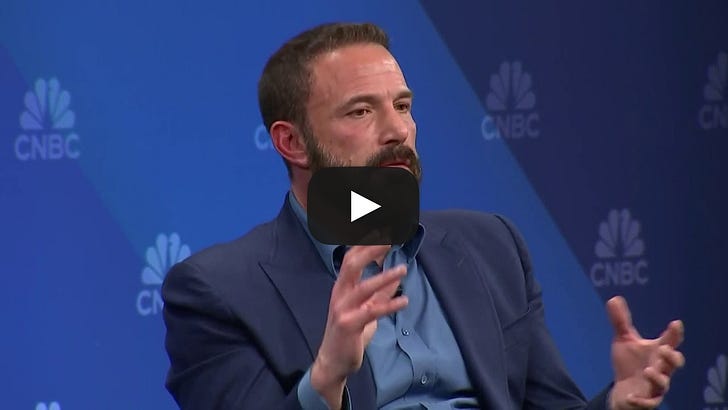
Go back through the interviews and a shape appears. He is not selling the future and he is not mourning it. He is dismissive of the fear, in a specific direction. He does not believe the machine is about to make a film from nothing, or write anything that matters. His most quoted line is that it can produce imitative verse that sounds Elizabethan, and that it cannot write you Shakespeare. He calls it a craftsman rather than an artist, able to sit beside a master and copy the technique, cross-pollinating what already exists without ever making anything new. He draws the line between the two in a single breath. Craft is knowing how to work, and art is knowing when to stop. Stopping, he says, is what the machine will struggle to learn, because stopping is taste. And in the same breath, without softening it, the cost. He would not want to be in the visual effects business, he says, because they are in trouble, and he is right that they are. He gives the arithmetic almost in passing: instead of five hundred people in Singapore paid two dollars an hour to render a superhero film, the machine will do it faster. He says it the way you read out a line item, because in that moment that is what they are to him. What the tool takes out is the laborious, less creative, more expensive part of the work, which brings the cost down and lets more people make the films they always wanted to make. He is describing a smaller crew, and a smaller crew has a plain meaning for the people no longer on it. He is sharp, too, about the other side of the noise, the companies who talk up a world about to change in order to justify the money they have already spent, when history, he says, shows adoption coming slowly and in increments. He is not choosing a side. He is standing on a position with a cost built into it and refusing to pretend the cost away. There is a reason I went looking in acting and not somewhere tidier. The film business runs on story, and story is the most human thing we have. It is how we worked out who we were before we could write it down, and it is still the test I use when almost nothing else moves me. I get to the cinema once or twice a year now, because I have become unbearable about it, unwilling to give three hours to anything without a real human pulse in it. One of those films this year will be The Odyssey, which I will see in the coming weeks. Christopher Nolan has taken Homer’s three-thousand-year-old poem about a man trying to get home and shot it entirely on IMAX film across six countries, in the most laborious, least automated way a film can still be made. And you know how much I love Chris Nolan movies. Odysseus is played by Matt Damon. Affleck’s oldest friend, the man he wrote Good Will Hunting with before either of them was anyone, his partner in the production company they later built to put filmmakers first. So in the same season, one of them is selling an AI engine that strips the laborious work out of production, and the other has spent months on location being a man on a ten-year journey home. They wrote one of the most human films of their generation together, and now they stand at opposite ends of the same question. Neither of them is wrong. While Damon has been marketing Odysseus, the rest of us watched the World Cup on our phones, and the World Cup this summer has been two tournaments at once. One is played on the pitch. The other is made in the feed, by AI. Open any of it and the football has been turned into something else. Messi, Mbappé and Lamine Yamal are redrawn as anime warriors with glowing auras, fighting for the trophy across a storyline that fans rewrite after every match. Gianni Infantino, the head of FIFA, introduces the semifinalists like final bosses entering an arena. Neymar, ageless, dribbles through a match that never happened. Some of it is wonderful. None of it exists without a person deciding what would be funny, what would move you, which clip cuts to which, where the joke sits. The machine renders it. A human still has to have the idea, and the taste, and the timing. That is Affleck’s cutting room, moved into a teenager’s bedroom. And the same feed, the same tool, carries the other thing. A video of Neymar gliding past Messi to score reached millions of people who took it for real, until someone checked and found no such match had been played. When Cape Verde held Spain, a story went round that their goalkeeper was a part-time electrician and bus driver moonlighting as a footballer, and people loved it, and it was invented, because the man has been a professional footballer for most of his adult life. Around the edges run thousands of scam adverts wearing the players’ faces. It is delight and deception from the same machine, in the same scroll, and a person decided which to make. I have started putting a question to the rooms I speak in. When you want to understand what AI is doing to human work, whose voice do you trust? The obvious answer is the people inside it, the founders and the labs, and there is real signal there. But they are also the people whose valuations depend on the story running a particular way, which Affleck pointed at himself. Some of the clearest thinking I have found comes from people whose whole life is something else, who have nothing to sell you and no reason to flatter the machine or to fear it on cue. Nick Cave, who has spent forty years writing songs, was sent lyrics a chatbot had produced in his style, and his reply became one of the sharpest things anyone has said about any of this. His answer was that algorithms have no feelings and data cannot suffer, that a real song is dragged out of a human struggle a machine has never been through and cannot counterfeit. And yet, pressed further, he does not play the refusenik. He says plainly that we are all immersed in this now, and that his quarrel is narrower than it looks, aimed only at the idea that making art is mundane enough for a machine to do it. Paul McCartney used AI to lift John Lennon’s voice off an old recording, clean, so that a half-finished song could be completed decades late. And then the same Paul McCartney stood in front of the British government and told it, in effect, that if it let the machine strip-mine musicians’ work, it would end up with no musicians. He used the tool to recover something he loved, and he fought the tool to protect the people coming after him. I went looking for all of them for a selfish reason. When I stand in front of a room and talk about the mindset the book calls augmented, the question comes back almost every time. What do you do? People want to watch someone move between the human thing and the machine thing and decide, in real time, which is which. For a while I gave them me. This is what I do, this is where I stop, this is the judgement I will not hand over. It worked. But it has started to tire me, being the only exhibit, and there is something thin about a man who can only ever hold up his own hands as the evidence. There is something thinner still about holding them up as if they were clean. I wrote a chapter on drift, and I drift. I have reached for the tool in the exact place I tell audiences to keep their hands off it, handed over work I should have kept, felt the small deadening that comes after, caught it, dug myself out, and reached for it again a week later. The book was never a dispatch from the far side of this. It is a set of notes from a man still in the middle of it. So when they ask, as they now do, whether there is anyone else, I tell them there is, and I tell them to read the book. Sabrina Ramonov is in there, one person doing a whole team’s weekly output and marking plainly what the machine touched. So is Sugar, running a beach bar in Thailand and outflanking bigger rivals with a chatbot. Neither has a face you would recognise, which is the only thing wrong with them as examples. Which is how I ended up on a man whose face does the work a stranger’s cannot. Christian Bale is the better Batman, and I am not going to pretend otherwise to make a cleaner argument. But Affleck has done in public, at a scale that got printed and priced, the thing I usually have to mime with my own two hands. The mistake people make is to treat this as a choice they get to make, in or out, for or against. You wake up and it is already in the room. It sorted the emails you read first and the ones you never saw. It is in the phone in your hand, the route it chose for your drive, the show the television put in front of you before you asked. It is at your work, in the tool a colleague used to draft the message you answered before breakfast. It may be in the room with your doctor, reading the scan a half-second before she does. You did not vote on any of this. It arrived. So the honest position is not on or off. Being against it changes nothing about how much of it you have already touched by ten in the morning, unless you plan to live as a hermit in a cave. It is more like where you stand in politics. Almost nobody is entirely on the left or entirely on the right. You are somewhere on the line, and the spot moves depending on the question in front of you, and pretending you sit at one pure end is a story you tell rather than a place you live. AI is that kind of line. The real question is where you are standing on it, and why, and what you are willing to move. Which is why the mindset was never one skill, a switch you flip on today and own tomorrow. It is the judgement to use the tool and the harder judgement to keep your hands off it, Affleck’s line about knowing when to stop, carried out of the cutting room and into an ordinary day. It is never a hundred per cent. Anyone who tells you it is has something to sell. You have a video and a patent too. The video is the reason you give. You use the tool to clear the dull, heavy work so your hours go to the work that is yours. You would call it more human work, and it was true when you said it. The patent is the part you keep off camera. The report that took half the time and slightly less of you. The email that reads well and cost you nothing. The skill you have stopped practising because the tool does it for you now. You are getting more human work, and in some ledger you do not read aloud, you are also doing more with fewer people. It is all true at once, and it is you, this week. The reason Affleck is worth a week of evenings is not that he escaped this. He is holding the same two documents you are, though not from the same place. Some own the machine, some pay for it, and some are the people it was built to do without. The contradiction is shared, but its rewards and its injuries are not. The discomfort of watching him is recognition. He is not the exception to your situation. He is the enlarged photograph of it, taken from the one seat that gets paid for the view. There is a third account, and nobody puts it on camera or in the patent. Call it the apprenticeship. That’s the space I talk about a lot. The junior who spent a year painting wires out of shots was not only removing wires. He was learning where the eye goes, what a frame can carry, when an image has been touched once too often. We call that work drudgery, but only once we already know how to do it. To the person still becoming good, it was the training. It was where the taste came from. Affleck says art is knowing when to stop, and that the machine will struggle with stopping because stopping is taste. He is probably right, and it is the wrong thing to be reassured by. Taste is not issued at birth, and it is not waiting upstairs for people to be promoted into it. It is built, slowly, out of exactly the work his company is designed to remove. The people who already have taste will be fine. The people who were going to earn it, a year of wires at a time, will find the first rung gone and the floor above them full. The video promises more human work. It does not say whose taste will still be allowed to form. The useful part arrives once the discomfort passes. The skill was never the absence of the contradiction. Anyone selling you a version that comes without a cost is selling you the thing Affleck refused to sell. The skill is the nerve to stand inside the contradiction with your eyes open and keep making the call, one case at a time. Where does the human belong in this one? Never in general, always in the particular. This task, this scene, this decision, today, with the answer free to move by tomorrow. Cave kept songwriting and let the rest go. McCartney used the machine to recover something he loved and fought it to guard the living. Affleck built the tool and named, out loud, the line he would not let it cross. None of them resolved anything. All of them decided. That kind of deciding is trainable. It is closer to a moral muscle than a technical one, which is why the book files it among the human skills and not the software. A muscle does not hold a position by itself. It tires. You lose the line, and you take it back, and the taking back is the skill. You get better at it the way you get better at any judgement, by making it out loud, in front of people who can see you, and being willing to be wrong there. Most of us make ours in private and never say the second half. He is not in my book. If this had happened a year earlier he would have been one of its clearest examples. That is how fast this is moving. Since the book came out, the question people ask has changed. Now people ask what is your next book called. Someone offers Drift versus Design. Someone else says The Augmented Mindset, or SuperSkills with a two after it. I tell them the truth, that I do not have another book in me, and that in any case you cannot write the last word on a thing you are still standing inside. I am still standing inside it. So is Affleck. So is everyone I have named. I watched the clip again last night. It does not slide past any more. I see it in people who tells me, with real conviction, that the tool has freed her people for higher work, and who has not filled the roles she stopped hiring for. I see it in the keynote where I point at my own hands and feel how thin that is. I see it in this piece, written faster than I could have five years ago, because I can go deep into the research and keep my brain curating the ideas. Ben Affleck is human. I do not mean it as praise. He is holding two documents that are both true and do not cancel each other out, and his scale put the second one on the record whether he wanted it there or not. That is what I make of him, and I said I would. The rest of us hold ours in the dark and call it clarity. He is not perfect, and he has stopped pretending to be. Neither am I, and I wrote the book. Neither are you, holding whatever you are holding as you read this. But we are not holding it from the same place. Some of us get to name our contradiction out loud, from a stage, and be admired for the honesty. Some of us are the line item that honesty is describing. The video tells you what the tool makes possible. The patent tells you what it costs. The apprenticeship tells you who will still be allowed to learn. Read all three, and start with the one in your name. SuperSkills: The Seven Human Skills for the Age of AI is out now from Kogan Page. The augmented mindset is one of the seven skills. Ben Affleck is not in the book, although he should be. Stay Curious - and don’t forget to be amazing,
PS. If your organisation is thinking about AI and human capability, I keynote and advise on this. Tools I Use:
SuperSkills in the Wild:Send me images of your copy of SuperSkills and I will include them here. Bonus points for creative locations, tourist spots, spotting of the book in the wild, in a book shop etc.
Recommended Reading:
If you enjoyed this, forward it to someone who’d find it useful. And if you haven’t yet, order SuperSkills at superskillsbook.com Rahim Hirji is the author of SuperSkills: The Seven Human Skills for the Age of AI (Kogan Page, July 2026) and founder of The SuperSkills Intelligence Company. Box of Amazing has been read by over 25,000 people across 50+ countries for ten years.
|





Comments