The Pulse: What can we learn from Bun’s rapid Rust rewrite with AI?

The Pulse: What can we learn from Bun’s rapid Rust rewrite with AI?To a sceptic, spending $165K to migrate Bun from Zig to Rust sounds very expensive. But to a realist, shortening a 1-2 year migration down to 11 days opens amazing new opportunities for devs.
Hi, this is Gergely with a bonus, free issue of the Pragmatic Engineer Newsletter. In every issue, I cover Big Tech and startups through the lens of senior engineers and engineering leaders. Today, we cover one out of four topics of a past The Pulse issue. Full subscribers received the article below a week ago. If you’ve been forwarded this email, you can subscribe here.
Fortunately, the situation is now resolved and Fable is available globally, and Jarred has published a detailed post about the project. Before we get into the migration, some context: Bun is a complex project, with lots of production software depending on it. Bun itself does many things:
Today, Bun has 22 million monthly downloads, and software like Claude Code and OpenCode depend on it, while hosting providers like Vercel, Railway and DigitalOcean do first-party support for Bun. Why a rewrite?Zig is not a memory safe language, and memory-related bugs occurred continuously. Jarred lists memory-related bugs in the latest version of Bun: memory leaks, crashes due to memory issues, heap-out-of-bounds writes, and so on. This was after the Bun team patched the Zig compiler to reduce memory-related issues, and put end-to-end memory leak tests in place. As Jarred says:
Moving to a memory-safe, yet performant language could eliminate such errors, and Rust is one such language that fitted the bill. Jarred:
However, doing a full rewrite on Rust has always been a terrible idea. Or at least, it used to be, because of how unberabaly long it would have taken: There are two problems with rewrites: they take too long, and they take waaaay too long. A dev who has done rewrites probably knows how things tend to go:
Jarred likened rewriting Bun in Zig to this:
Rewriting Bun with FableUnsurprisingly, the rewrite was not as simple as typing a prompt like: “Claude, rewrite Bun in Rust. Make zero mistakes.” Instead, this is how Jarred did it: Step #1: Prep work. Three hours of intense prep work with Claude, explained Jarred:
This guide is a 600-line file with instructions like:
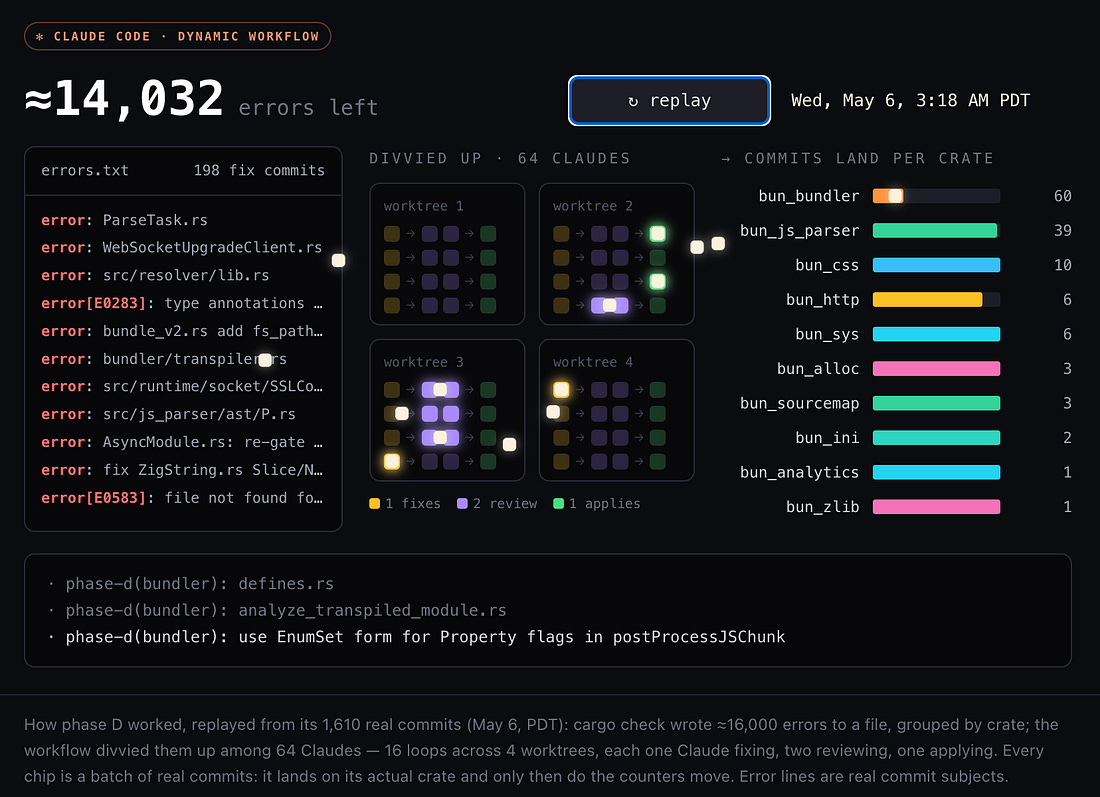
It’s a series of instructions that makes sense to someone who’s expert in Rust. If you want to learn more, we cover Rust basics and why Rust is different, with Alice Ryhl. Step #2: Trial run + adversarial review. Asking Claude to rewrite three files of 1,448 total number of files. After the rewrite, Jarred ran two separate adversarial reviews with Claude to critique the result, in separate sessions than the one that Claude made the changes in. Step #3: split up the work across 64 AI agents. Jarred split up the job so that agents worked on files independent from one another, in parallel. Step #4: iron out issues with the run (~1 day). When Jarred attempted to run all this, agents kept getting in each other’s way:
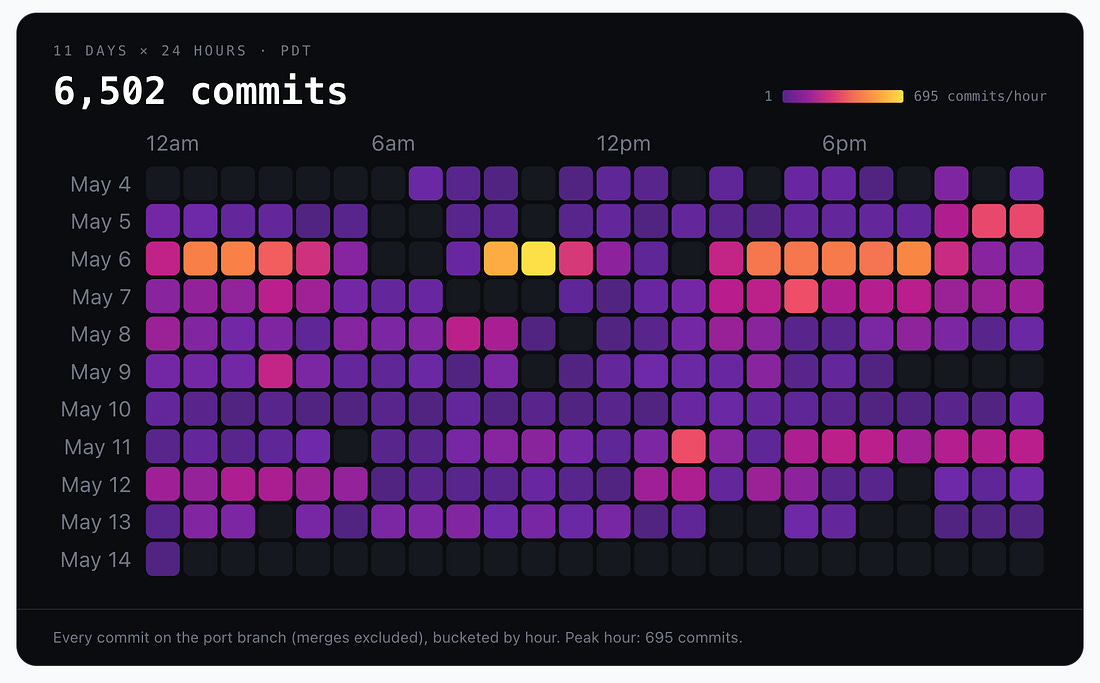
Step #5: have it run and wait ~2 days. The parallel agents went to work, and completed the rewrite of 535,496 lines of Zig code over the course of two days. Each commit was checked by two adversarial reviews, before being committed. Step #7: fix ~1,600 compiler errors (~12 hours). The rewrite was completed, but nothing compiled. Going crate-by-crate (‘crate’ is Rust’s concept of a top-level compilation unit), Jarred had Claude fix compiler errors. This alone would be a herculean task for an engineer, but not for Claude:
The enjoyable thing about this phase of the migration was that the agents ran from midnight until 11:30am, fixing compiler bugs on their own – when Jarred and the team were getting some sleep. Step #8: run tests locally (~2 days). Bun has a large test suite. The next step was to get these tests to run without compilation errors. Step #9: get the test suite to pass CI (~3 days). Once the tests were running (and failing), the next step was to fix the code, so that the tests could pass. This took two days. Step #10: Done in 11 days! After all the tests passed and Jarred verified that everything worked as expected, he merged the changes. The whole process took 11 days, from planning to the finish.
How repeatable is this process?The rewrite cost a whopping $165,000 with API pricing. With Fable’s API prices, the rewrite consumed 5.9 billion uncached input tokens, 690 million output tokens, and 72 billion cached input token reads. Anthropic sells API tokens at a margin as its business, so the cost of the rewrite for it was lower. It’s a large amount: the equivalent of the annual base salary for a software engineer at a mid-tier company in the US! But then again, could have an engineer done all this work in a year? Probably not, and Mitchell Hashimoto says the same:
What if AI enables rewrites and migrations that wouldn’t have been considered before? The idea of rewriting Bun in Rust without AI was impractical, admits Jarred:
A rewrite or migration taking months or years is why so many of these projects never happen. Let’s take aside the cost for a minute and consider this question: if AI can shorten a one-year rewrite to a week: would you do it? If the answer is “hell, yes:” a blueprint now exists in the form of the Bun migration on how to do it. There are some caveats not detailed in the post, though:
In fairness, #3 is the weakest point because we know LLMs are pretty good at “mundane” work like code migrations. With a good test suite (#2) and a motivated engineer to iron out things (#1), you’ll more likely than not succeed. The remaining question is how much can be spent. It will likely not be $165K: and costs can be reduced with a simpler project, or by being thoughtful about model usage. For example, do high-level planning with the most expensive model, and cheaper ones for coding and review tasks. Migrations with AI are surely speeding up, but only when projects are well-engineered like Bun’s has been. Read the full issue of The Pulse this excerpt is from, or check out the latest The Pulse from today. Today’s issue covers:
You’re on the free list for The Pragmatic Engineer. For the full experience, become a paying subscriber. Many readers expense this newsletter within their company’s training/learning/development budget. If you have such a budget, here’s an email you could send to your manager. This post is public, so feel free to share and forward it. If you enjoyed this post, you might enjoy my book, The Software Engineer's Guidebook: navigating senior, tech lead, staff and principal positions at tech companies and startups.
|






Comments