 Halifax County USDA Service Center - January 16, 2026 In This Issue: 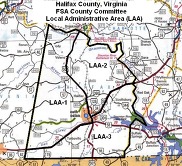 The 2025 Farm Service Agency County Committee Elections will begin on January 5, 2026, when ballots are mailed to eligible voters. The deadline to return ballots to the Halifax County FSA office, or to be postmarked, is February 2, 2026. County committee members are an important component of the operations of FSA and provide a link between the agricultural community and USDA. Farmers and ranchers elected to county committees help deliver FSA programs at the local level, applying their knowledge and judgment to make decisions on commodity price support programs; conservation programs; incentive indemnity and disaster programs for some commodities; emergency programs and eligibility. FSA committees operate within official regulations designed to carry out federal laws. To be an eligible voter, farmers and ranchers must participate or cooperate in an FSA program. A person who is not of legal voting age but supervises and conducts the farming operations of an entire farm, may also be eligible to vote. A cooperating producer is someone who has provided information about their farming or ranching operation(s) but may not have applied or received FSA program benefits. Eligible voters in local administrative area LAA 1 (North of US Highway 58 and West of US Highway 501) in Halifax County who do not receive a ballot can obtain one from the Halifax County Farm Service Agency, 171 South Main Street, Halifax, Virginia 24558. Newly elected committee members will take office March 2, 2026. The candidates in this year's election for LAA 1 are: James Garrett Church is nominated in LAA 1, Halifax County, to serve as a County Committee Member for a 3-year term. James resides in Sutherlin and has produced tobacco, wheat, soybeans, and livestock for 15 years. James currently participates in USDA-FSA farm programs and is willing to serve if elected. Bernard Jerome Logan is nominated in LAA 1, Halifax County, to serve as a County Committee Member for a 3-year term. Bernard resides in Vernon Hill and has produced beef cattle and hay for 20 years. Bernard is an active member of the of the 2020 Farmers' Cooperative and Virginia Agribusiness Council. Bernard currently participates in USDA-FSA farm programs and is willing to serve if elected. More information on county committee elections can be found at fsa.usda.gov/elections or by contacting the Halifax County FSA office at (434) 476-6558 ext. 2. | Top of page  USDA Halifax County Farm Service Agency (FSA) reminds producers of approaching application deadlines for purchasing risk coverage for some crops through the Noninsured Crop Disaster Assistance Program (NAP). NAP provides financial assistance to producers of non-insurable crops impacted by natural disasters that result in lower yields, crop losses, or prevented crop planting. NAP covers losses from natural disasters on crops for which no permanent federal crop insurance program is available, including forage and grazing crops, fruits, vegetables, floriculture, ornamental nursery, aquaculture, turf grass and more. Upcoming application deadlines for NAP coverage in Halifax County for the 2026 production season include: - February 17, 2026 - Forage and Grazing Crops
- February 17, 2026 - Numerous Fruits & Vegetable Crops
NAP basic coverage is available at 55% of the average market price for crop losses that exceed 50% of expected production. Buy-up coverage is available in some cases. NAP offers higher levels of coverage, ranging from 50% to 65% of expected production in 5% increments, at 100% of the average market price. Producers of organic crops and crops marketed directly to consumers also may exercise the "buy-up" option to obtain NAP coverage of 100% of the average market price at coverage levels ranging between 50% and 65% of expected production. Buy-up coverage is not available for crops intended for grazing. For all coverage levels, the NAP service fee is the lesser of $325 per crop or $825 per producer per county, not to exceed a total of $1,950 for a producer with farming interests in multiple counties. Premiums apply for buy-up coverage. If a producer has a Socially Disadvantaged, Limited Resource, Beginning and Veteran Farmer or Rancher Certification (form CCC-860) on file with FSA, it may serve as an application for basic coverage for all eligible crops beginning with crop year 2022. These producers will have all NAP-related service fees for basic coverage waived. These producers may also receive a 50% premium reduction if higher levels of coverage are elected on form CCC-471, prior to the application closing date for each crop. To learn more about NAP visit fsa.usda.gov/nap or contact the Halifax County USDA Service Center at (434)-476-6558 Ext. 2. |  USDA announced the next phase in the Farmer Bridge Assistance Program (FBA), the eligible commodity per-acre payment rates. In 2026, $12 billion will be paid to American farmers. Of that amount, $11 billion consists of one-time FBA program payments. Eligible Row Crop Commodities and Payment Rates: Below are the payment rates for the FBA eligible commodities that triggered a payment. Commodity, Per Acre Payment Rates • Barley: $20.51
• Canola: $23.57
• Chickpeas (Large): $26.46
• Chickpeas (Small): $33.36
• Corn: $44.36
• Cotton: $117.35
• Flax: $8.05
• Lentils: $23.98
• Mustard: $23.21
• Oats: $81.75
• Peanuts: $55.65
• Peas: $19.60
• Rice: $132.89
• Safflower: $24.86
• Sesame: $13.68
• Sorghum: $48.11
• Soybeans: $30.88
• Sunflower: $17.32
• Wheat: $39.35 Eligibility, Program Applications, and Crop Insurance Linkage FBA payments are based on 2025 planted acres, Economic Research Service cost of production, and the World Agriculture Supply and Demand Estimate Report. Double crop acres, including all initial and subsequently planted crops, are eligible. Prevent plant acres are not eligible. All intended row crop uses are eligible for FBA except grazing, volunteer stands, experimental, green manure, crops left standing and abandoned or cover crops. Crop insurance linkage is not required; however, USDA strongly urges producers to take advantage of the new risk management tools provided for in the One Big Beautiful Bill Act (OBBBA) to best protect against future price risk and volatility. The OBBBA federal crop insurance improvements include expanding benefits for beginning farmers and ranchers, increasing coverage options, and making crop insurance more affordable. Specialty Crop Assistance Of the $12 billion being provided by the Commodity Credit Corporation Charter Act, up to $11 billion is being directed to eligible row crop producers and the remaining $1 billion of the $12 billion in assistance is reserved for specialty crops and sugar. Timelines for payments to producers of these crops are still under development and require additional understanding of market impacts and economic needs. Producers, including specialty crop producers and stakeholder groups, can submit questions to farmerbridge@usda.gov. More information on FBA is available online at https://www.fsa.usda.gov/fba or you can contact the Halifax County USDA Service Center at (434)-476-6558 Ext. 2. | Top of page  Farm Service Agency (FSA) is committed to providing our farm loan borrowers the tools necessary to be successful. FSA staff will provide guidance and counsel from the loan application process through the borrower's graduation to commercial credit. While it is FSA's commitment to advise borrowers as they identify goals and evaluate progress, it is crucial for borrowers to communicate with their farm loan staff when changes occur. It is the borrower's responsibility to alert FSA to any of the following: - Any proposed or significant changes in the farming operation
- Any significant changes to family income or expenses
- The development of problem situations
- Any losses or proposed significant changes in security
If a farm loan borrower can't make payments to suppliers, other creditors, or FSA on time, contact your farm loan staff immediately to discuss loan servicing options. For more information on FSA farm loan programs, contact the Mecklenburg County USDA Service Center at 434-738-6133 ext. 5 or visit fsa.usda.gov. |  USDA recently announced a $700 million Regenerative Pilot Program available in all 50 states to assist American farmers in adopting practices that improve soil health, enhance water quality and boost long-term productivity, all while strengthening the nation's food and fiber supply. Administered by the USDA's Natural Resources Conservation Service (NRCS), this new program delivers a streamlined, outcome-based conservation model—empowering producers to plan and implement whole-farm regenerative practices through a single application. During Fiscal Year 2026, the Regenerative Pilot Program will focus on whole-farm planning that addresses every major resource concern—soil, water and natural vitality—under a single conservation framework. USDA is dedicating $400 million through the Environmental Quality Incentives Program (EQIP) and $300 million through the Conservation Stewardship Program (CSP) to fund this first year of regenerative agriculture projects. Learn more about the Regenerative Pilot Program. | Top of page  Special Emphasis: This Month - January Dates to Remember: January 19 – Office Closed for Martin Luther King Day January 23 – Signup Deadline for OFSCLP January 29 – County Committee Meeting February 2 – Last Day for Waived Late Filed Provisions for Acreage Reporting February 2 – COC Election Deadline February 11 – COC Election Ballots to be Counted February 16 – Office Closed for Presidents' Day February 17 – Deadline for NAP Application for Coverage for Most Fruits, Vegetables, Hay and Pasture April 30 – Signup Deadline for SDRP Stage 1 & 2 Within 72 hours – NAP participants must report losses and completion of harvest on hand harvested and rapidly deteriorating crops. Within 15 days – Report losses to crops insured under NAP (excluding hand harvested and rapidly deteriorating crops). Ongoing – Submit an AD-1026 PRIOR to the land being cleared for agricultural use (forest and new ground) and PRIOR to hay and pasture field being converted to a row crop or vegetable crop. Ongoing – Contact our office with farm record changes and banking information updates. Interest Rates: Operating/Ownership Loan:
Farm Operating - 4.625%
Farm Ownership - 5.625%
Farm Ownership - Joint Financing: 3.625%
Farm Ownership - Down Payment: 1.625%
Emergency - Actual Loss: 3.750% Farm Storage Facility Loan:
3-year term - 3.500%
5-year term - 3.625%
7-year term - 3.875%
10-year term - 4.125%
12-year term - 4.250% Marketing Assistance Loan:
Commodity Loan - 4.625% | Halifax County USDA Service Center P. O. Box 728
Halifax, Virginia 24558-0728 Phone: 434-476-6558
Fax: 855-592-3190 Office Hours:
M-F 8:00 am-4:30 pm Find your local USDA Service Center | | Halifax County FSA Office
434-476-6558 Ext. 2 Wayne R. Yarbrough, Jr., CED randy.yarbrough@usda.gov Lauren H. Milam, PA lauren.milam@usda.gov Hunter D. Shelton, PA Hunter.Shelton@usda.gov County Committee:
Blair W. Hall
Patrick S. Jennings
Dale E. Miller
Ronnie G. Owen, Jr.
Next County Committee Meeting:
January 29, 2026 @ 9:00am
| Pittsylvania County Farm Loan Team Phone: 434-432-9455 Ext. 4 Ronald A. Kraszewski, FLM ron.kraszewski@usda.gov Natural Resources Conservation Service (NRCS) 434-476-6558 Ext 3 Hannah Warren, District Conservationist
hannah.warren@usda.gov | | The Halifax County Farm Service Agency Committee is scheduled to meet on Wednesday, January 29, 2026 at 9:00am. Reasonable accommodations will be made, upon request, for individuals with disabilities, vision impairment, or hearing impairment to attend or participate in meetings. Persons with disabilities who require accommodation to attend or participate in this meeting should contact Wayne R. Yarbrough, Jr., at 434-476-6558, ext. 2, or by email at: randy.yarbrough@usda.gov, or by Federal Relay Service at 1-800-877-8339. | |







Comments