| Welcome back. The battle for AI supremacy is shifting from raw intelligence to personal context — and Google just played its strongest card. | The company's new 'Personal Intelligence' feature lets Gemini tap into Gmail, Photos, YouTube, and Workspace all at once. While competitors scramble to build integrations, Google is turning its apps that billions use every day into a moat. | Also: How to use OpenCode for coding, how PMs are using coding agents, and 7 rules for engineering next-level prompts. |
| | |
| Today's Insights | Powerful new tools for devs Ex-Google engineer's Claude Cowork guide How an ex-Meta engineer uses Claude Code Trending social posts, top repos, new research & more
| | Welcome to The Code. This is a 2x weekly email that cuts through the noise to help devs, engineers, and technical leaders find high-signal news, releases, and resources in 5 minutes or less. You can sign up or share this email here. |
| | |
| | |  | Click to learn more about Personal Intelligence. Source: Google. |
|
|
| Gemini learns to connect the dots across your Google apps: The search giant just launched Personal Intelligence, a feature that lets Gemini pull context from Gmail, Photos, YouTube, Workspace, and Search all at once. Instead of relying on general knowledge or one app at a time, Gemini now retrieves approved data across your Google apps at request time — no long-term memory stored. It's opt-in and disabled by default. | OpenAI launches ecosystem for building multi-provider AI apps: The AI lab just dropped Open Responses, an open-source ecosystem that lets developers build agentic systems across different LLM providers — without rewriting code every time they switch models. It includes consistent streaming events, tool-use patterns, and a shared schema that works cleanly across providers. | Claude Code learns to travel light with large toolsets: As MCP adoption grows, developers are running into a scaling problem — teams with 7+ MCP servers burn through 67k+ tokens just loading tool descriptions. Claude Code now detects when schemas exceed 10% of the context window and switches to loading only the tools that match each task. No protocol changes are required on the server side. |
| | |
| | | | Most companies get stuck tinkering with prompts and wonder why their agents fail to deliver dependable results. This guide from You. com breaks down the evolution of agent management, revealing the five stages for building a successful AI agent and why most organizations haven't gotten there yet. | In this guide, you'll learn: | Why prompts alone aren't enough and how context and metadata unlock reliable agent automation Four essential ways to calculate ROI, plus when and how to use each metric Real-world challenges at each stage of agent management and how to avoid them
| If you're ready to go beyond the prompt, this is the playbook for you. |
| | |
| | TRENDS & INSIGHTS | What Engineering Leaders Need to Know This Week |
|
|  | Source: The Code, Superhuman |
|
|
| What happens when PMs no longer need engineers to prototype: A Google PM argues that coding agents are compressing the traditional handoff between product and engineering. Instead of writing specs for engineers to interpret, PMs now prototype directly with agents, then bring engineers in to make it production-ready. The bottleneck is now knowing what to build, not building it. | Why do most AI agents break in production: Most teams building AI agents are flying blind — catching bugs only after users complain. Anthropic's new engineering playbook changes that. It claims that you don't need hundreds of test cases to start. Just 20-50 tasks based on real failures will do. Teams with solid evals can upgrade to new models in days while competitors spend weeks scrambling. | Why your best engineering proposals keep getting rejected: It's not the idea — it's the delivery. CTO Anna Shipman breaks down how to bridge the gap between engineering and the C-suite. Her advice: execs optimize for company-wide impact, not technical elegance. Lead with an executive summary, quantify the ROI, and translate "tech debt" into dollars lost. Bottom line up front, always. |
| | |
| | IN THE KNOW | What's trending on socials and headlines |
|
| 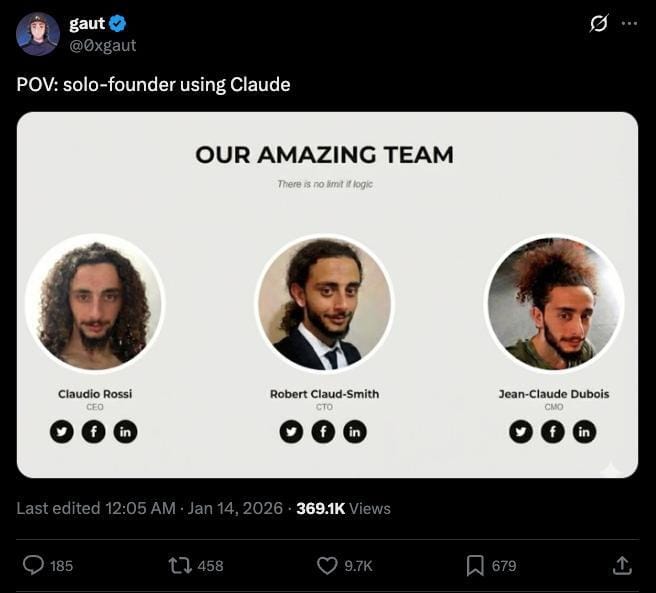 | Meme of the week |
| Prompt Mastery: This guide shares 7 rules for engineering next-level prompts. Turns out, the magic happens before you type a single word. Cowork Playbook: An ex-Google engineer wrote the complete guide to Claude Cowork — with 25 use cases, prompt templates, and tips you can steal. Startup Season: A founder compiled 40 reasons why now is the golden age for startups. From AI agents as cofounders to zero-gatekeeper distribution, the opportunity is massive. Vibe-Coded Browser: Cursor's CEO used GPT-5.2 to build an entire browser in just one week — 3M+ lines of code. Simple websites actually render correctly (Read the blog here).
| | Z.ai presents GLM-Image, an open-source model built for precise semantics and complex visual tasks. OpenCode launches open-source coding agent with 75+ model support. OpenAI makes GPT-5.2-Codex model available to developers via the Responses API, extending the model's availability beyond the company's Codex platform. Replit launches mobile app creation, letting users build, test via QR code, and publish directly to the App Store from a single platform.
|
| | |
| | TOP & TRENDING RESOURCES | 3 Tutorials to Level Up Your Skills |
|
|  | Click here to watch the OpenCode tutorial. |
|
|
| How to use OpenCode: Learn how to set up OpenCode, an open-source AI coding agent for the terminal. You will see how to install the tool, integrate various AI models, and leverage its "Plan" and "Build" modes to rapidly develop full-stack applications, offering a powerful, private alternative to paid coding assistants. | Claude Code 102: The viral guide we shared last week now has a sequel, diving into skills, subagents, and MCP connectors. Skills let you teach Claude your team's specific workflows, while subagents spin up isolated context windows for complex tasks. MCP connections let you pull from GitHub, Slack, and databases without ever leaving the interface. | How an ex-Meta engineer builds entire features with Claude Code: Building complex features used to take months. Now, ex-Meta engineer Ashpreet Bedi says he built one of Agno's most advanced features in just 5 days using Claude Code. His approach relies on spec-first development with structured design docs, layered CLAUDE.md instructions, and runnable cookbooks for every pattern. He still reviews every line — he just doesn't type it. | | Top Repos | React Best Practices: A structured repository for creating and maintaining React Best Practices optimized for agents and LLMs. JSON render: A library that enables AI models to generate predictable React UIs by restricting them to a developer-defined catalog of allowed components and actions. Claude code router: A middleware tool that decouples the Claude Code CLI from Anthropic, allowing you to power the interface with any AI backend — including DeepSeek, OpenAI, Gemini, or local models via Ollama.
| | Trending Papers | Engram (by DeepSeek): Language models waste energy recalculating simple, unchanging patterns instead of just remembering them. This paper introduces Engram, a method that adds an instant memory check for these patterns, freeing up the model to handle complex reasoning much more effectively. | Dr. Zero (by Meta): Training search agents typically requires expensive human data or massive computing power for complex tasks. Dr. Zero solves this by enabling AI to teach itself through external searches, matching or beating human-trained models without needing any initial data. | UniversalRAG: Most RAG systems struggle by forcing text, images, and video into one confusing search space. UniversalRAG fixes this by smart-routing queries to the exact media type and detail level needed, significantly boosting accuracy. |
| | |
| Whenever you're ready to take the next step | | What did you think of today's newsletter?Your feedback helps us create better emails for you! | | You can also reply directly to this email if you have suggestions, feedback, or questions. | Until next time — The Code team |
| | |
|
|


Comments