 Potter County USDA News - December 30, 2025 In This Issue: Farm Service Agency (FSA) Potter County Notes: NAP Participants- please submit 2025 production. Natural Resources Conservation Service (NRCS) Potter County Notes: EQIP and CSP application deadline ends 1/15/26. Upcoming Events: January 1, 2026- Happy New Year! USDA Service Centers will be closed. January 19, 2026- Martin Luther King, Jr holiday. USDA Service Centers will be closed. Questions? Deadline data? Contact the local USDA Service Center 605-258-2613 for detailed information or check out farmers.gov on-line! Top of page A farmers.gov account provides self-service opportunities to Farm Service Agency (FSA) and Natural Resources Conservation Service (NRCS) customers through a secure, authenticated access process. A new feature now provides access to your current or prior year FSA-578, Report of Commodities (Nationwide Producer Print). Your FSA-578 contains annual crop acreage reporting information submitted to USDA's Farm Service Agency (FSA). If you are a shareholder (operator, owner or other producer) for a crop on the acreage report, you will be able to view, save and/or print your selected annual FSA-578. How to Access Your FSA-578's From the Land tab in your farmers.gov account, click Land Overview on the navigation drop-down. On the Land Overview page, you will see an information block that states "View and Print Your Acreage Reports" containing a View Your FSA-578 button. Clicking the button will open a popup modal with a drop-down menu to select the acreage report year. Once you have selected a year, the View FSA-578 button becomes active. Clicking the button will open a new tab with a message indicating the PDF file is being loaded. Once the load is complete, the FSA-578, Report of Commodities (Nationwide Producer Print) PDF document is displayed. You can view, save and/or print the FSA-578 as needed. If there is no acreage report information on file for the selected acreage report year, the PDF will display the message, "This producer does not have a producer print currently available." How to Access FSA-578s Using Your Representative Authority to Act on Behalf of Another Customer Additionally, if you have been granted the authority to act on behalf of another individual or entity, you can use the yellow banner to "Switch Profile" and view the current or prior year FSA-578, Report of Commodities (Nationwide Producer Print) for the customer you on whose behalf you have been elected to act. Contact your local FSA office for more information or questions regarding your FSA-578, Report of Commodities (Nationwide Producer Print) or if you have questions regarding establishing representative authority or do not see the expected representative authority options when you log in. More information can be found in the farmers.gov Fact Sheet and video tutorials. Visit the farmers.gov Account page to log in or learn how to create an account. Using the correct signature when doing business with FSA can save time and prevent a delay in program benefits. The following are FSA signature guidelines: · Married individuals must sign their given name. · Example—Mary Doe and John Doe are married. When signing FSA forms, each must use their given name, and may not sign with the name of their spouse. Mrs. Mary Doe may not sign documents as Mrs. John Doe. For Farm Loan Purposes, spouses may not sign on behalf of the other as an authorized signatory, a signature will be needed for each. For a minor, FSA requires the minor's signature and one from the minor's parent. There are certain exceptions where a minor's signature may be accepted without obtaining the signature of one of the parents. Despite minority status, a youth executing a promissory note for a Youth Loan will incur full personal liability for the debt and will sign individually. Note: By signing a document with a minor, the parent is liable for actions of the minor and may be liable for refunds, liquidated damages, or other penalties, etc. When signing on one's behalf the signature must agree with the name typed or printed on the form or be a variation that does not cause the name and signature to be in disagreement. Example - John W. Smith is on the form. The signature may be John W. Smith or J.W. Smith or J. Smith. Or Mary J. Smith may be signed as Mrs. Mary Joe Smith, M.J. Smith, Mary Smith, etc. FAXED signatures will be accepted for certain forms and other documents provided the acceptable program forms are approved for FAXED signatures. Producers are responsible for the successful transmission and receipt of FAXED information. Examples of documents not approved for FAXED signatures include: · Promissory note · Assignment of payment · Joint payment authorization · Acknowledgement of commodity certificate purchase Spouses may sign documents on behalf of each other for FSA and CCC programs in which either spouse has an interest, unless written notification denying a spouse this authority has been provided to the county office. Spouses cannot sign on behalf of each other as an authorized signatory for partnerships, joint ventures, corporations or other similar entities. Likewise, a spouse cannot sign a document on behalf of the other in order to affirm the eligibility of oneself. Any member of a general partnership can sign on behalf of the general partnership and bind all members unless the Articles of Partnership are more restrictive. Spouses may sign on behalf of each other's individual interest in a partnership, unless notification denying a spouse that authority is provided to the county office. Acceptable signatures for general partnerships, joint ventures, corporations, estates, and trusts must consist of an indicator "by" or "for" the individual's name, individual's name and capacity, or individual's name, capacity, and name of entity. By Shala Larson, Public Affairs Officer— USDA NRCS South Dakota 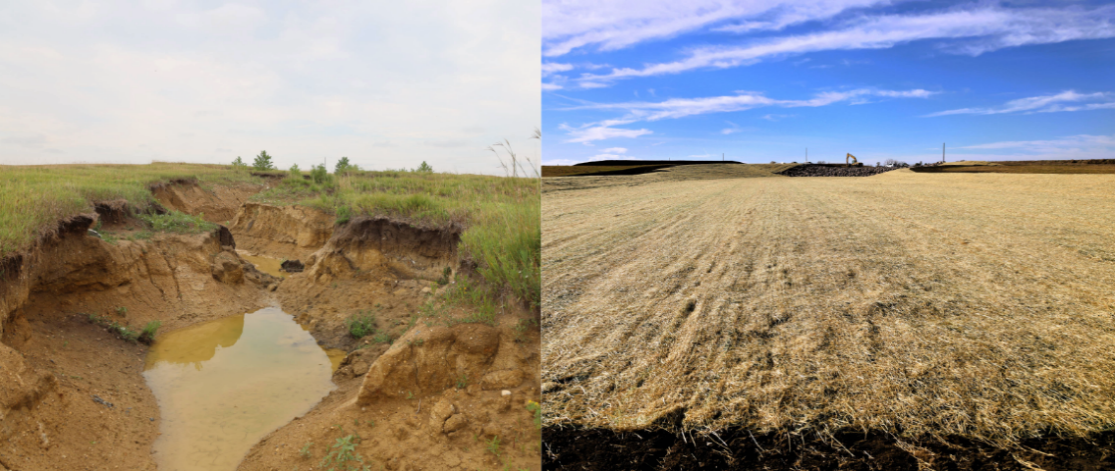 The left photo is the pre-construction, upstream view of the gulley, and the right photo is of the completed project taken in the same location. The United States Department of Agriculture's (USDA) Natural Resources Conservation Service (NRCS) in South Dakota (SD) offers natural disaster assistance through the Emergency Watershed Program (EWP), which provides technical and financial assistance to help local communities and sponsors relieve imminent threats to life and property caused by floods, fires, windstorms, and other natural disasters that impair a watershed, not requiring a disaster declaration by federal or state government officials for program assistance to begin. Lake Dimock is a 20-minute drive south of Mitchell and is near a township road and a private landowner's property. This lake has two spillways, with the primary concrete spillway at the north end of the dam embankment, and the secondary earth/grass "auxiliary" spillway near the center of the embankment. Water will run through the primary spillway first, then, if the elevation of the water gets high enough, it flows through the secondary auxiliary and over the township road. Twice within the last five years, during the extreme snowmelt and rainfall events in 2019 and 2024, extreme flooding caused damaging flows through the secondary auxiliary that spilled out into the neighboring landowner's pasture. Those extremely powerful flows of water created a massive gully. If not fixed, another extreme rainfall event would likely have caused the gully to worsen, eventually eroding upstream, working its way through the road, and eventually even draining the lake. If that type of erosion had occurred, it would have disrupted traffic, emergency services, and potentially disrupted power and telecommunications for the surrounding residents. To remedy this issue, NRCS's EWP was utilized to repair the gully by installing a rock rip rap chute through a signed project agreement with SD Game, Fish and Parks (GFP), owner of Lake Dimock, and the project sponsor. 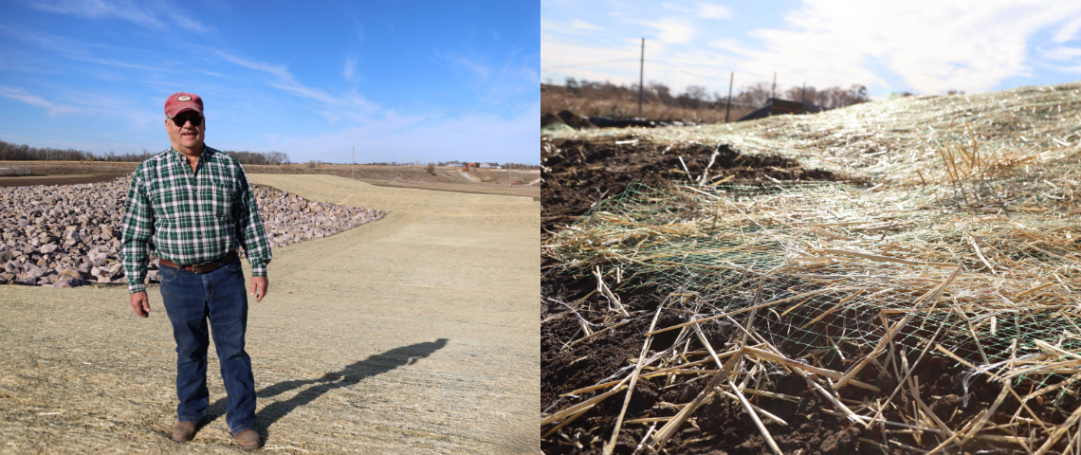 Bill Kummer standing in front of the newly established rip rap (left photo) and a close-up of the temporary straw erosion control blanket (ECB), which will provide cover for the seeded grass and cover crop during the winter months (right photo). The neighboring landowner, Bill Kummer, granted permission for the project. When asked about the completed project, Bill replied, "I'm really pleased with it; the aesthetic is great." In the meantime, to prevent erosion and encourage grass and cover crop growth in the spring, 100% weed-free straw was laid on top of the seeded field, which is secured in place in between two layers of degradable photosynthetic netting that will slowly degrade from sun exposure in four to six months, more formally known as an erosion control blanket (ECB), which will provide security against elemental erosion throughout the winter. The seed mix used for this field was the Department of Transportation's type "G" mix, which includes switch grass, Indian grass, big bluestem, and Western wheat grass, with rye serving as a cover crop. Kummer plans to let freshly planted grass and cover crops establish before ever cutting it for hay. 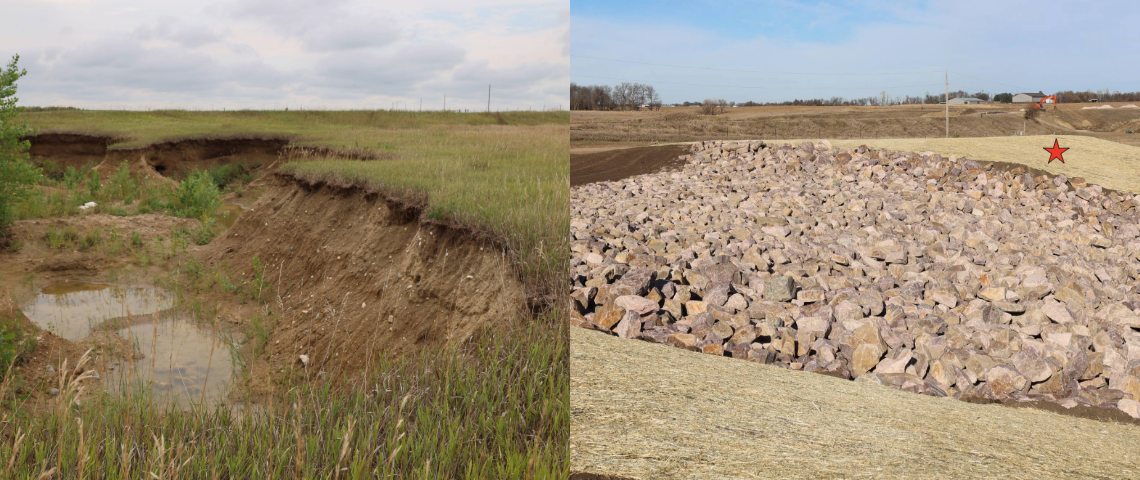 The head cut and gully in the auxiliary spillway facing north before construction (left photo), and after riprap construction facing north (right photo)—to better visualize, a red "x" marks where the "before construction" photo was taken. The gully was made by water flowing from west to east. Working in tandem with our partner in conservation, GFP awarded a construction contract to Lidel Construction of Sioux Falls, with construction staking and inspection led by Banner Associates. Engineer James Gilkerson with GFP designed the project—a final review of the design was completed by NRCS engineers. When disasters occur, NRCS programs, including the EWP, can support a sponsor's design and plan for a locally led recovery effort. Visit your local NRCS office to discuss your goals and learn how an NRCS specialist or program can support and expand your operational efforts. USDA is an equal opportunity provider, employer, and lender. FSA and NRCS program applicants for benefits are required to submit a completed CCC-902 Farming Operation Plan and CCC-941 Average Gross Income (AGI) Certification and Consent to Disclosure of Tax Information for FSA to determine the applicant's payment eligibility and establish the maximum payment limitation applicable to the program applicant. Participants are not required to annually submit new CCC-902s for payment eligibility and payment limitation purposes unless a change in the farming operation occurs that may affect the previous determination of record. A valid CCC-902 filed by the participant is considered to be a continuous certification used for all payment eligibility and payment limitation determinations applicable for the program benefits requested. Participants are responsible for ensuring that all CCC-902 and CCC-941 and related forms on file in the county office are updated, current, and correct. Participants are required to timely notify the county office of any changes in the farming operation that may affect the previous determination of record by filing a new or updated CCC-902 as applicable. Changes that may require a new determination include, but are not limited to, a change of: - Shares of a contract, which may reflect:
- A land lease from cash rent to share rent
- A land lease from share rent to cash rent (subject to the cash rent tenant rule
- A modification of a variable/fixed bushel-rent arrangement
- The size of the producer's farming operation by the addition or reduction of cropland that may affect the application of a cropland factor
- The structure of the farming operation, including any change to a member's share
- The contribution of farm inputs of capital, land, equipment, active personal labor, and/or active personal management
- Farming interests not previously disclosed on CCC-902 including the farming interests of a spouse or minor child
- Certifications of average AGI are required to be filed annually for participation in an annual USDA program. For multi-year conservation contracts and NRCS easements, a certification of AGI must be filed prior to approval of the contract or easement and is applicable for the duration of the contract period.
Participants are encouraged to file or review these forms within the deadlines established for each applicable program for which program benefits are being requested. Top of page The U.S. Department of Agriculture's (USDA) updates to the Farm Service Agency's (FSA) Farm Loan Programs are officially in effect. These changes, part of the Enhancing Program Access and Delivery for Farm Loans rule, are designed to increase financial flexibility for agricultural producers, allowing them to grow their operations, boost profitability, and build long-term savings. These program updates reflect USDA's ongoing commitment to supporting the financial success and resilience of farmers and ranchers nationwide, offering critical tools to help borrowers manage their finances more effectively. What the new rules mean for you: · Low-interest installment set-aside program: Financially distressed borrowers can now defer up to one annual loan payment at a reduced interest rate. This simplified option helps ease financial pressure while keeping farming operations running smoothly. · Flexible repayment terms: New repayment options give borrowers the ability to increase their cash flow and build working capital reserves, allowing for long-term financial planning that includes saving for retirement, education, and other future needs. · Reduced collateral requirements: FSA has lowered the amount of additional loan security needed for direct farm loans, making it easier for borrowers to leverage their existing equity without putting their personal residence at risk. These new rules provide more financial freedom to borrowers. By giving farmers and ranchers better tools to manage their operations, we're helping them build long-term financial stability. It's all about making sure they can keep their land, grow their business, and invest in the future. If you're an FSA borrower or considering applying for a loan, now is the time to take advantage of these new policies. We encourage you to reach out to your local FSA farm loan staff to ensure you fully understand the wide range of loan making and servicing options available to assist with starting, expanding, or maintaining your agricultural operation. To conduct business with FSA, please contact your local USDA Service Center. Top of page The U.S. Department of Agriculture (USDA) Farm Service Agency (FSA) reminds foreign investors with an interest in agricultural land in the United States that they are required to report their land holdings and transactions to USDA. The Agricultural Foreign Investment Disclosure Act (AFIDA) requires foreign investors who buy, sell or hold an interest in U.S. agricultural land to report their holdings and transactions to the USDA. Foreign investors must file AFIDA Report Form FSA-153 with the FSA county office in the county where the land is located. Large or complex filings may be handled by AFIDA headquarters staff in Washington, D.C. According to CFR Title 7 Part 781, any foreign person who holds an interest in U.S. agricultural land is required to report their holdings no later than 90 days after the date of the transaction. Foreign investors should report holdings of agricultural land totaling 10 acres or more used for farming, ranching or timber production, and leaseholds on agricultural land of 10 or more years. Tracts totaling 10 acres or less in the aggregate, and which produce annual gross receipts in excess of $1,000 from the sale of farm, ranch, forestry or timber products, must also be reported. AFIDA reports are also required when there are changes in land use, such as from agricultural to nonagricultural use. Foreign investors must also file a report when there is a change in the status of ownership. The information from AFIDA reports is used to prepare an annual report to Congress. These annual reports to Congress, as well as more information, are available on the FSA AFIDA webpage. Assistance in completing the FSA-153 report may be obtained from the local FSA office. For more information regarding AFIDA or FSA programs, contact the Potter County FSA office at phone or visit farmers.gov. Landowners and operators are reminded that in order to receive payments from USDA, compliance with Highly Erodible Land (HEL) and Wetland Conservation (WC) provisions are required. Farmers with HEL determined soils are reminded of tillage, crop residue, and rotation requirements as specified per their conservation plan. Producers are to notify the USDA Farm Service Agency prior to breaking sod, clearing land (tree removal), and of any drainage projects (tiling, ditching, etc.) to ensure compliance. Failure to update certification of compliance, with form AD-1026, triggering applicable HEL and/or wetland determinations, for any of these situations, can result in the loss of FSA farm program payments, FSA farm loans, NRCS program payments, and premium subsidy to Federal Crop Insurance administered by RMA. Potter USDA Service Center 507 E Garfield Ave
Gettysburg SD 57442 Phone: 605-765-2575 Fax: 855-262-1936 Next Potter County Committee Meeting: January 21, at 8:30 a.m. - Questions? Contact Dawn M. Nagel at dawn.nagel@usda.gov
- If you would need to request an accommodation, please contact the FSA office at 605-765-2575 ext. 2 or email sdgettysbu-fsa@one.usda.gov one week prior to meeting date to request accommodations (e.g., an interpreter, translator, seating arrangements, etc.) or materials in an alternative format (e.g., Braille, large print, audiotape – captioning, etc.).
Fax: 855-262-1936 | | | | | | | Resource Hubs: https://www.farmraise.com/usda-fsa www.farmers.gov www.farmers.gov/working-with-us/common-forms | | 






Comments