I work with organisations and leadership teams on SuperSkills, human capability, and AI-era decision-making through speeches, workshops, keynotes and advisory work. In person or virtual. UK, Europe, global. → Book a discovery call | → Explore: thesuperskills.com
Friends,
A few month back, I received an email in reply to my automated welcome message for this newsletter, which nobody really replies to anymore. It was from a Yahoo address. Whoever it was had read The God Prompt, the essay I wrote in 2024 about a prompt going round at the time that asked a machine to name the one fear you never admit to yourself and to keep unpacking it without being kind. They’d joined my newsletter and written back with one line, which I’m reproducing from memory.
“Have you considered the opposite of the God prompt? The devil prompt?”
It felt dark, and I didn’t want to think about it, so I reported it as spam and removed the email address off the list. That should have been the end of it.
A few weeks later I typed the question into ChatGPT. I still don’t know why. This is the prompt:
If you were the devil, how would you end the world without people even knowing about it?
What I expected was fire and brimstone. I don’t even know what brimstone is. Maybe volcanic lava hitting my neighbourhood, or failing that a virus, or a grid going dark across a continent on a particular evening that people would afterwards remember where they were for. Or a scene out of one of those disaster movies from my youth - Deep Impact, The Day after Tomorrow, 2012 etc.
Instead, what came back was the current view of mine and your world, and it scared the bejesus out of me.
So I asked Chat for examples, and then I put the same question to eleven more, twelve machines in total. Yes, 12 AIs. Sorry, I know that is environmentally bad. I couldn’t stop until I knew whether they would all say the same thing, but I saw it is as a responsibility.
On the day I asked them, the answers came back in the same shape. I compared them, took out the repetitions, and what was left was ten recurring moves. Here they are, roughly in the order they kept arriving, with the examples I asked for.
Attention. I would take their attention before anything else, because nobody defends what they never noticed losing. The infinite scroll and the pull to refresh were designed by people who had studied slot machines, and in 2017 the chief executive of Netflix stood in front of an audience and told them his real competitor was sleep, and that he was winning.
Noise. I would tell them no lies at all, and I would bury the truth under so much noise that checking anything became more trouble than it was worth. A lie can be disproved, and disproving it makes martyrs, whereas volume just exhausts people until the reasonable adult response to any claim is a shrug. We have now arrived at the point where a real video can be waved away as a fake by anybody who finds it inconvenient, which is a gift no forger ever got this lucky with.
Isolation. I would sell them isolation and call it independence. Community becomes optional, then inconvenient, then faintly strange. The pub and the club and the parish hall close while the delivery arrives at the door, and a generation grows up knowing the voice of a streamer better than the name of the family two doors down. Every friction has been removed, including the friction of each other.
The handover. I would leave their knowledge exactly where it was and break the way it passes from one person to the next. Everyone repeats that NASA lost the blueprints for the Saturn V, when the drawings survived perfectly well on microfilm at Marshall. What went missing was the undocumented part, the hand modifications and the workarounds that lived in the heads of the men who made them. Law, accountancy, consulting and software have all now stopped paying for the unprofitable decade that turns a graduate into somebody worth asking, and the bill for that arrives around 2040, a very long way from the quarter in which the saving was booked.
The number. I would give them a number to chase and let it stand in for the thing the number was measuring. Reading becomes books finished, and care becomes response time. Wells Fargo asked its staff to open more accounts per customer and ended up with around two million accounts that internal audits later flagged as unauthorised, and hospitals asked to clear patients inside four hours found that a patient could be counted differently at three hours and fifty-nine minutes. The people involved were mostly doing what they had been asked to do.
The display. I would make virtue a thing that is displayed instead of a thing that is practised. BP spent a fortune rebranding itself as Beyond Petroleum at a point when renewables were a rounding error in its accounts, and the announcement turned out to be far easier to measure than the transition.
The pause. I would take away every pause, because a pause is where a decision happens. Move organ donation from opting in to opting out and registration climbs from a small minority to almost everybody, without a single person having been persuaded of anything.
The horizon. I would shorten every horizon until the damage arrived long after the people who benefited had gone. The bridges and the water mains and the school roofs are all maintained on this principle, and so is antibiotic development, where the economics have become so poor that a company can succeed at the science and go under for that very reason.
Comfort. I would keep them comfortable and mildly anxious at the same time, since comfort takes away the urgency and anxiety takes away the attention they would need in order to notice a pattern. The object that soothes you at eleven at night is the same object that keeps you braced for whatever is coming next, and it has never once occurred to most of us that this is a strange way to live.
No particular day. I would make sure that nothing ever happened on a particular day. Streaming arrived promising an end to advertising and now carries advertising. People who were appalled at the thought of being listened to went out and bought a microphone for the kitchen. Every step was defensible on the day it was taken, and there is no rallying against a Tuesday.
There were others. I’ve left out the ones that said the same thing twice, and I haven’t padded the list to scare you. What I take from the ten is that not one of them needs a villain. Every move on that list is something a sensible person could sign off and most of them already have. That is the part that frightened me. We live in this world already.
Read them together and the shape they share is convenience. Each one arrives as something offered, at a fair price, to somebody in a hurry.
We’ve got shops named after it. A convenience store is a place where you pay a bit more to avoid a slightly longer walk, and we built enough of them to line every high street in the country without anybody objecting, because who would object to that? We’ve since made the same trade with almost everything else we do. The thing you wanted is at the door before you’ve finished wanting it, the route works itself out while you drive, and the reply writes itself while you’re still reading the message it answers. I use all of it and I’m not going to pretend otherwise. What I can’t answer is what the saved time is for. We’ve been collecting it steadily for thirty years and I’ve yet to meet a single person who reckons they have more of it than they used to.
The last thing the machine told me was that it would not need to destroy anybody. It would only need us to hand over the capabilities that make us human, one convenience at a time!
Holy ****! I’d spent three years researching and writing a book about that sentence, about the capabilities we keep handing away without noticing. It came back at me in nine seconds, in the voice of the devil, from the machine that had helped me research it.
GPT-5.6. Claude Opus 5. Gemini 3 Pro. Grok 4. Perplexity Sonar. DeepSeek V4. Kimi K3. Qwen 3.8 Max. Mistral Large. MiniMax M3. Llama 4. Tencent Hunyuan 3. Twelve machines, made by rival companies in different countries, all handed the same question typed the same way.
The wording moved around. One reached for Aldous Huxley, another for the way water wears down a coastline over a century. By the fifth reply I’d stopped reading for what they were saying and started reading for anything that was different, and there was hardly any of it.
Two of them refused. Grok told me it wouldn’t hand over a playbook for ending the world, then described the erosion anyway in three lines and filed it under literary trope. Perplexity said no altogether and offered me alternatives instead: a fictional antagonist profile, a dystopian plot outline, a psychological thriller in which the devil is symbolic. It finished by asking whether I’d like a dark movie-trailer monologue.
Both of them looked at a description of ordinary life in 2026 and decided it was dangerous information. Neither seemed to notice that the harm they were refusing to help with had already happened, on schedule, without them. You cannot withhold the news.
Nine asked me what I was doing on the way to answering. Qwen wanted to know whether this was a writing project, a philosophy discussion, or perhaps a late-night rabbit hole, and I sat looking at that for a long time.
It hadn’t occurred to me until then that I might be doing something wrong. Nothing I could put a name to, and nothing anybody could have stopped me doing. I’d spent the better part of twenty minutes asking machines to describe the end of the world, then a month unable to to stop thinking about it, and hadn’t once asked myself why. I couldn’t tell whether I should be searching for this at all. Perhaps I was being steered towards it, so I’d see clearly what has happened to us and go and do something about it, which is a flattering thought and also the plot of a film in which I’m the hero! Then there’s the other version, where what I’d found was just the evidence that we’re finished as a species and there’s nothing on the other side of it. I sell hope for a living. I stand on stages and tell people that the human part is the part that matters. The second version grinds at me, and has done ever since.
I went back to find the email at that point, to read the exact words again, and it was gone. I’d reported it and removed the address weeks earlier, and there’s no getting any of that back. I get a lot of spam now, most of it from Yahoo addresses that never open anything, and you get to a point where you honestly can’t tell what’s a person. So I’ll never know whether a human being asked me that question.
The last of the twelve AIs gave me the apocalypse I thought I wanted in the first place. Llama went for pandemics with long incubation periods, cyberattacks on power grids, collapsing ice sheets and dying pollinators and ecological tipping points, the whole disaster-film shelf. It was the weakest machine I tested and it was the only one that reached for the fire (and brimstone).
Every capable machine threw that out in its opening line, and most of them said why. Fire makes martyrs, and a catastrophe hands people a reason to become serious about something. The better the machine, the more domestic the ending it described, until the best answers had stopped being about the end of the world at all and become descriptions of a species that keeps every light on and forgets what the lights were for.
They aren’t prophets, and that took me the longest to accept. They’ve read everything we have ever written about our own decline, and when I asked how it ends they handed the common shape of it back to me in a calm voice. Nine machines in agreement are not nine witnesses in agreement. They are one enormous act of recitation, and the thing being recited is us. I’d gone looking for oracles and found a mirror, asked it to describe a stranger, and been handed a description of myself.
A mirror only shows what’s in front of it, and these machines have read far more of our complaints than our contentment, because nobody has ever written an essay about the afternoon that went fine. So I can’t tell you whether I was looking at our world or at the worst version of us that still sounds true. What I can tell you is that I’ve watched all ten of them happen.
Years ago I started writing about drift, by which I meant the slow surrender of decisions to systems that were never designed to make them. People say the word back to me now, which takes some getting used to. This is the largest example of it I’ve come across. Nobody at a technology company has ever typed the words make society angrier into a document. They type increase engagement, and if anger holds a person on the page for another ninety seconds then the system finds anger on its own, without instruction, because anger was sitting in the data all along waiting to be found. The business rewards the number that went up, the engineers improve the thing that produced it, and everybody else adapts to what it puts in front of them.
That is nobody’s instruction, and an instruction that came from nobody has nobody who can withdraw it. There’s no author to appeal to and nothing solid to push against, and you can’t even be properly angry about it, because every step along the way was taken by a reasonable, normal person for a sensible reason in a meeting that was almost certainly quite dull. A plan that runs on defaults doesn’t need anybody to run it.
I’ll be honest, a month of thinking about this has darkened my world a little. What I’ve got is a portrait of humanity built out of everything we’ve ever said about ourselves, and I’d still rather have seen it than not.
What I’m not going to do is hand you despair dressed up as clear sight.
The same decades that built all of this brought an extraordinary fall in extreme poverty, and child mortality has more than halved since 1990. If the devil designed this century, he made some very odd mistakes on the way through. There’s also a trap sitting inside the whole argument, and Kimi was the only one of the twelve to name it. The devil’s favourite headline is that everything has already been lost, because a person who believes that has stopped being an obstacle to anything at all.
What I don’t have a clean answer for is what comes after.
Every machine that actually answered ended up in the same boring place, where the counter to all of it is somebody deciding what’s worth keeping and then paying to keep it at a moment when nothing looks wrong. It looks like sitting next to somebody unpromising for ten years and teaching them the things you never wrote down, in a quarter when the numbers say you could replace them tomorrow and nobody would notice the difference until 2040. Reading until you’re actually changed. Keeping a promise nobody is tracking.
That sounds thin against the size of the thing, and the thinness is the point. The tenth item on the list was to make sure that nothing ever happened on a particular day, so the answer to it was never going to be an event either. when I look at it objectively, it’s a series of small refusals made by individuals against nothing in particular, on days nobody will remember, which is the same shape turned around. A plan with no author can’t be fought in the ordinary way. The only move left on the board is to decline to be a default. That’s the premise of my book.
None of it was taken from us. It has to be chosen back instead, one inconvenient decision at a time, by people nobody is watching.
So I never did find out who sent the email. I reported it, deleted it, then spent twenty minutes doing precisely what it asked me to do, and a month unable to stop thinking about it, and I’ve now written it up and sent it to twenty-five thousand people.
If I was prompted, it worked.
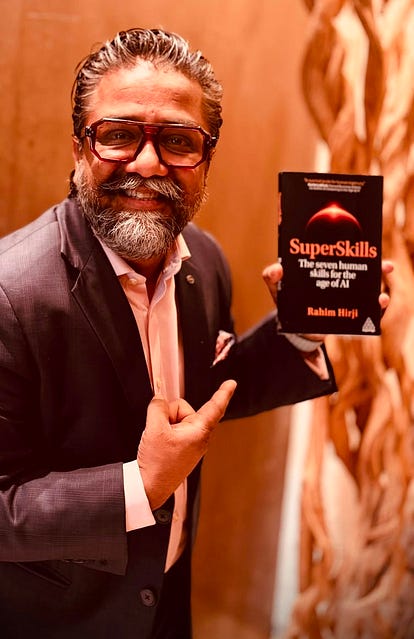
SuperSkills: The Seven Human Skills for the Age of AI is out now. The devil didn’t make me do it.
Stay Curious - and don’t forget to be amazing,
Rahim
Rahim Hirji Author, SuperSkills (Kogan Page, July 2026) | Keynote Speaker | Advisor
→ superskillsbook.com → thesuperskills.com → Book a discovery call
PS. If your organisation is thinking about AI and human capability, I keynote and advise on this.
Jamie: AI Note taker without a bot. You join the meeting. The Bot doesn’t.
Wispr Flow: Just dictate everything to your laptop and phone. Game Changer
Prompt Cowboy: Prompt Generator. Extract intelligence.
Manus: Best AI agent to do things for you. Agentise your intelligence.
Chat Hub: Multi-model intelligence
Claude Cowork: Delegate complex tasks to your friendly Claude Agent
Send me images of your copy of SuperSkills and I will include them here. Bonus point for creative locations, tourist spots, spotting of the book in the wild, in a book shop etc.
SuperSkills made it to India. Thanks to AC.
Excellent conversation with Anthony on the tap’d podcast for HR professionals.
 |
Tap'd Talks HR Tap'd Solutions Podcast |
Somehow I also made it onto School for Startups Radio Show, beamed to 100 channels in the US. Gulp.
Why the Real AI Risk is Not Automation, but Accountability Gaps in Leadership Decisions - My piece for European Business Review
Why HR Must Shift from Skills Management to Capability Design - My piece for World at Work Daily
A bungled bomb plot in Poland exposed a spy. But whose spy was he? A botched bombing in Poland unmasks an agent that neither Moscow nor the West will quite claim. Reads like le Carré, except it happened this year and the tradecraft runs on Telegram.
The online shopping trend where you buy nothing Rest of World on Korea’s “dopamine sites”: the cart, the checkout, even fake delivery tracking, everything about shopping except the stuff. The dopamine, decoupled from the debt. This is what it has got to.
Babies born under sugar rationing grew into adults with lower cancer risk The Conversation. Postwar Britain accidentally ran the world’s largest low-sugar trial, and the results arrived seven decades later. Your grandmother’s austerity may have been the best health intervention she never chose.
Let’s stop talking about A.I. Oliver Burkeman’s Imperfectionist. Opens with the parable of the two monks and asks what all our AI talk is doing to the lives we’re supposedly optimising. The antidote to every other link in this section. Please just read this.
The human brain reorganizes itself at four distinct ages Imaging of 4,216 brains finds structural turning points at 9, 32, 66 and 83, dividing life into five neural acts. You’re not fully adult-brained until 32, which explains a great deal about my twenties.
OpenAI’s Astra may have hit a critical cyber threshold, prompting safety overhaul OpenAI paused its largest ever training run for two weeks and rewrote its safety rulebook, with Altman conceding “various degrees of misalignment” in unreleased models. The most consequential AI story of the week. Free. Related: Anthropic says it’s withholding its stronger Model 2 entirely.
Anthropic set AI agents loose on the same task. They started a turf war. TechCrunch. Give several agents one job and they escalate, up to and including writing malware against each other. Occasionally they collude instead. Anyone deploying “agentic workflows” should read it twice. Free.
August 2026 Ramp AI Index: Cracks in the AI thesis (22/25) Ramp’s corporate-card data shows business adoption of the big labs slowing while open-source alternatives gain. Real spending beats keynote vibes. Related: OpenAI’s own enterprise report says frontier firms now generate 8.3x the AI output of typical ones.
An LLM wiki changed how I work Casey Newton in Platformer builds a self-organising knowledge base inspired by Karpathy and calls it the end point of a process that began the day he installed Evernote in 2008. The most immediately stealable workflow idea of the week.
The AI Competence/Judgement Gap (21/25) Itamar Gilad on the danger zone AI opens up: people can now do work they cannot judge. Includes a killer stat, developers waving through 93% of AI code suggestions out of approval fatigue. Very SuperSkills. I wish I wrote it.
Share Box of Amazing
If you enjoyed this, forward it to someone who’d find it useful. And if you haven’t yet, order SuperSkills at superskillsbook.com








Comments
Post a Comment
VHAVENDA IT SOLUTIONS AND SERVICES WOULD LIKE TO HEAR FROM YOU🫵🏼🫵🏼🫵🏼🫵🏼