I work with organisations and leadership teams on SuperSkills, human capability, and AI-era decision-making through speeches, workshops, keynotes and advisory work. In person or virtual. UK, Europe, global. → Book a discovery call | → Explore: thesuperskills.com
Friends,
An ask: If you bought your copy of SuperSkills from Amazon, please will you review the book to help spread the word. An honest review of what you liked, what was in the book and what resonated with you. That would honestly be amazing!
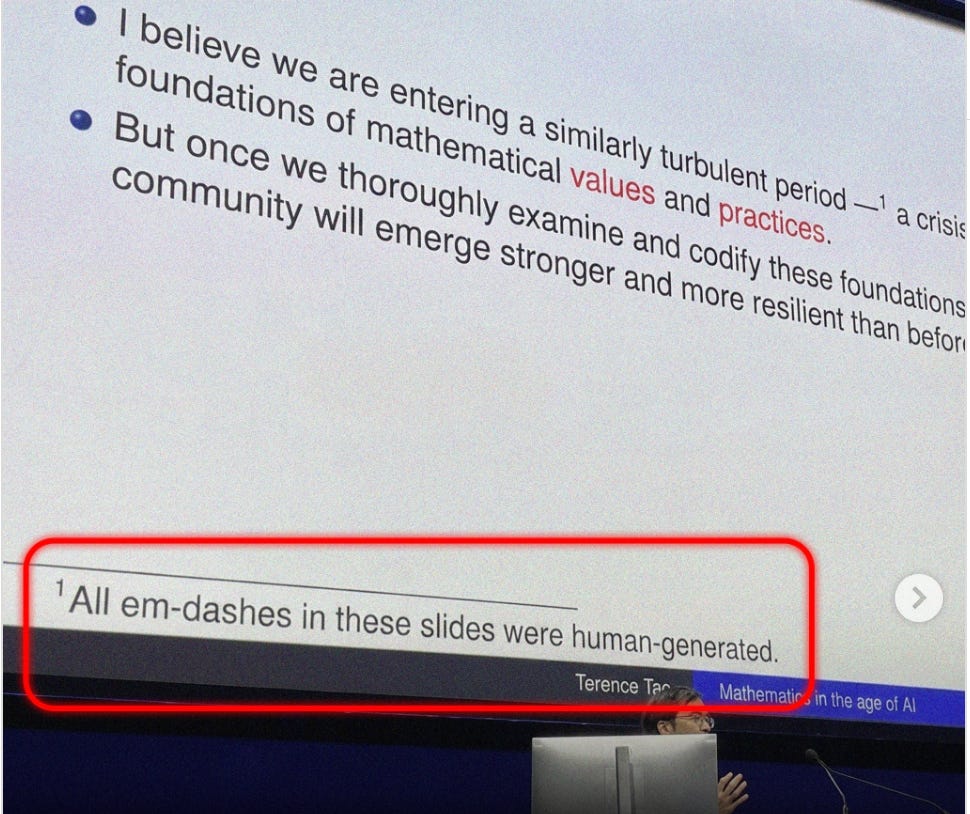
This week, I received the same screenshot in three group chats. It’s a slide from a lecture, with a pretty generic sentence about entering a turbulent period and a crisis in the foundations of mathematical values and practices. yada yada yada. At the end of that sentence, there is a small raised number. At the bottom of the slide, where the footnote sits, it says that all em-dashes in these slides were human-generated.
The lecture was given by Terence Tao at the International Congress of Mathematicians in July. Geek Central. The talk was about what happens in the maths world now that machines can produce proofs faster than people can check them. He described a shift from “proof scarcity to proof abundance”. Similar problems that us non-geeks have. Then came the massive pile-up when generation outruns verification. He called it ‘proof indigestion.’
So the lecture was about a discipline losing its ability to verify things at the speed they arrive. And the single claim in the entire deck that carries no external check, that rests on nothing but his word, is the one about his punctuation. The irony. He used a footnote, which exists to point at evidence, to say something for which there’s no evidence at all. He asked to be taken at his word! I found this fascinating.
Those of us who come from where I come from are at the mercy of the EU. There is a new trigger, Article 50 of the EU AI Act, which has resulted in Anthropic starting to embed a watermark in the text the machine generates. If you copy it between locations or try to clean it, it is almost like money laundering. The watermark stays, even though you can’t see it. The EU requires machine-generated content to be marked in a machine-readable way, and I think for the foreseeable future AI content will be tagged like this, not just on Claude but across all the models. That said, finding a mark tells you the text went through a model. It doesn’t tell you who wrote it, or who did the thinking. And if there’s no watermark, that doesn’t prove AI wasn’t used.
Both “marks” were made in the same fortnight. One was imposed on the machines by law and can be washed out by editing. The other was applied by a mathematician to himself, by hand, and nobody can verify it.
I know a product manager who does that very job during the day, and in the evenings and on Saturdays he runs copycat YouTube channels built with Fable 5, which does the writing, and he coaches people, gives the occasional talk, and sells prompt libraries on Gumroad. Some of it earns him cash.
I am envious. Why? It’s not the money. It’s not even the capability. It is the speed, and what the speed buys, which is more speed. It buys the rocket ship.
His YouTube channels replicate formats that already work, essentially cartoon generations at a rate that would have been impossible for one man two years ago. I noticed that the watermark was designed to survive exactly that motion, the copy and the paste, and then I stopped noticing anything about him at all for a while. Thousands of people are doing this. That’s my point. Anyone with access to AI can copy what anyone is doing. It’s not just about words.
I asked him about a new product he’s launching and I heard him say let’s see “how it lands”, for what I realised was the fourth or fifth time. It didn’t sound human. He didn’t sound human. He was turning into a machine.
Researchers at the Max Planck Institute for Human Development took the words that chatbots reach for when they polish a piece of writing, words like delve and showcase and meticulous and realm, and tracked them across 737,083 hours of podcast conversation. The researchers excluded episodes they could identify as scripted. The rise begins after ChatGPT arrives and the analysis ties the two together. The words did not just stay on your documents or slop. They have moved into what comes out of your mouth. We are talking slop. The slop has landed.
The same research found the effect was absent in podcasts about sport, religion and spirituality. One reason may be that those are subjects where people already have a language of their own and don’t need anyone else’s.
TikTok and Instagram are now full of people performing the voice on purpose, the eager helpfulness and the small summarising flourish at the end, and it’s funny because everybody can hear it.
You see the unfunny version in people who have never written anything before. Someone who has posted nothing for six years arrives on LinkedIn with paragraphs in threes, a sentimental register nobody uses out loud, and a pensiveness that doesn’t belong to them, because they are not pensive, and I have sat in meetings with them. The words are only the surface. The real giveaway is that there’s no earlier version of them anywhere - and for those that know them personally, know that they haven’t got that level of thinking. A funny new confident voice appears with absolutely zero history behind it. And history is the one thing you can’t fake on demand.
My friend has a history. He has a decade of unremarkable posts behind him and you can watch the moment the voice changes.
The clearest case this year was a politician in Canada. Bill Oliver spoke during a debate about whether the province should create the post of energy advocate. He said that public confidence in the office of an advocate matters, and then he carried on reading, and what he read out was a request for a more natural, flowing version of that section. He did it again later. The speech ran close to forty minutes. At least three passages of the machine’s private notes to itself went into the permanent record of a legislature, spoken aloud by an elected man in a debate about accountability. When it went round the internet six weeks later he defended himself by comparing the tool to an encyclopaedia. A detection firm went through about eight thousand speeches in that same legislature and found that 3% looked machine-written in 2022, and that this year it’s nearly 25%.
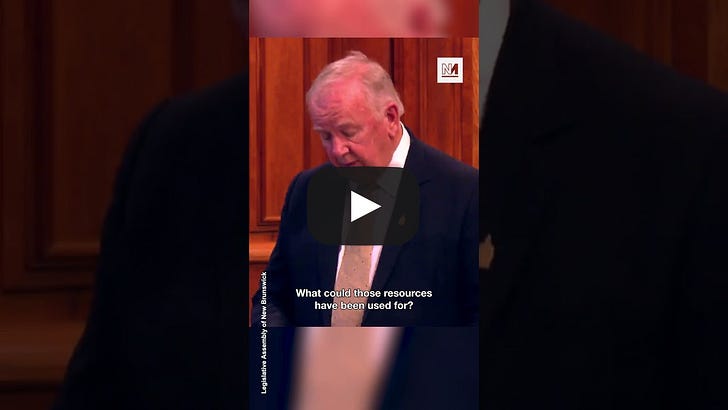
Oliver read out an instruction to sound more natural, and he sounded exactly as natural as a man reading out an instruction to sound more natural.
There is another world I didn’t know about until I launched my book. My spam folder has several hundred invitations to include SuperSkills in an online book club. Apparently a known scam. They love the book. They admire all the points. They mention the skills. Nobody wrote them. They’re not humans. At the same time, people I have never met comment on my LinkedIn posts within a minute of publication, agreeing warmly with something they cannot have read. I cringe. It’s worse than slop. It’s something else.
A machine has written to me several hundred times about a book on being human, and asked only that I reply.
Who are these people? Who are these bots? And why?
The researchers call this cognitive offloading, which is what happens when you hand a mental task to something outside your head and your head adjusts accordingly. I feel like I notice it less in the vocabulary than in the argument beneath the vocabulary. Conversations that used to be a back and forth of four now run two and then resolve, tidily, in a way that sounds like agreement and is closer to fatigue, like you might tire with a chatbot.
Every time this situation of “did a machine write this” comes up, and it comes up weekly now, someone reasonable points out that the words were never the point. What matters is the thinking and whether the idea reaches the reader, and if a tool helps you say the thing more clearly then the fuss about vocabulary is snobbery with extra steps. I understand the argument. I have made a version of it myself.
But this is why the argument doesn’t hold. The proof of the thinking came from the build-up in the prose, the build-up of an essay, the build-up of what you are creating. I don’t believe people can now come to a conclusion that is so clever without having done the thinking or taken the time, which is why, when I see these deep essays that come from nowhere, I can’t believe the supposed brilliance is real. What we used to have were ghost writers who had the art of creating content. We also had secretaries who would perfect what other people had drafted, a different kind of polish. What we have now is two types of content. There is content that has gone through a multitude of thinking. And there is content that has arrived at the multitude of thinking but is actually quite vacuous. It’s exhausting to decipher, because the onus is now on the reader, not on the writer.
Someone told me recently that the quality bar has gone up from 60% to 90%. Everything you ship now needs to be almost perfect, with layers of intellect interwoven in the words. We started on that journey with spell checkers, then grammar checkers, and now we have squiggles under words telling us when something doesn’t quite look right or make sense. Whatever you are trying to communicate, whether the words come directly from your brain or from a machine, has to be perfect, or at least 90% perfect. The only difference you have left is style and taste.
This is Tao’s problem exactly. His field has more proofs than it can check. The rest of us have more sentences than we can check, and I don’t know whether we are already too far past it to go back.
I have been on the receiving end of this. In December a journalist I had given interview answers to wrote and asked me directly whether I had used AI, because his detection tool had returned an eighty-nine per cent likelihood that my answers were machine-generated. I had written every word myself from a hotel room in Turkey. I replied within minutes to say so, he accepted it, and eight days later he published the piece with me as one of three sources and gave me the last word. It ended well.
But I couldn’t prove it. I could only say it. Tao did the same thing with his footnote. The difference is that he volunteered his and I was asked for mine.
So I changed how I write, and it was not about pride. Part of what I do is I advise people. If I read as a human who runs everything through a machine, the next inference is that their material goes through it too, and that inference costs more than any sentence is worth. I used to like the word “quietly” and I used it in speech for years. I liked “insidious” even more, mostly because of the film. I avoid both now, not because they stopped being good words but because of what a stranger might conclude from finding them.
Nobody consulted me. My product manager friend picked up “landed” without noticing. I put two words down while I was still using them. The same machine did both, in the same season, and neither of us agreed to it. I’m not sure he knows.
Where he goes from here I cannot say. He might make a great deal of money in the next three years and stop, and I would find that hard to be gracious about. There is a possibility neither of us would choose, which is that he is early, that being early is the whole of the skill, and that copying at speed is the most copyable thing there is.
I remember in 1999 there were a bunch of quasi-technical people who got rich in the wild west of the dot-com boom by creating websites. I reckon that lasted a couple of years. Soon after, everyone could create their own website, including me, and the question became whether it was worth it, or good enough. The people who made those early sites couldn’t answer that question. They were just moving at speed.
Tao heard it well enough to footnote his own punctuation. Oliver could not hear it coming out of his own mouth on the record. My friend is between them, moving faster than either, saying let’s see how it lands to a room that has lost the ability to tell.
I have started listening to myself while I am still speaking.
None of it made any difference. I have been writing articles for publications this year to PR my book, and every one of them requires in writing that no AI is used in the drafting, which I agreed to and meant, and signed a docusign. One editor came back after I filed and asked for the whole piece to be rewritten because it was not practical enough, a requirement that had not appeared in any brief I was given. I nearly said no. Then I did it, all of it and submitted again. When I saw it live, I nearly spat out my Robinson’s Barley Water. What I saw was reordered and smoothed, and it carried em dashes I had never typed. People whose entire trade is words had put a finish on it that announces the words were not handled. It’s like a dining table lacquered so heavily that nobody wants to put a plate down on it. WAY TOO MUCH POLISH!
My name is on that piece. Tao footnoted his own punctuation and asked to be believed. I cannot footnote mine, because I did not put it there, and nobody is going to ask.
One final irony. I’ve just put this essay through the Pangram checker on Substack and it says this piece is 66% AI. Maybe I’m now 2/3 robot?
Rahim Hirji is the author of SuperSkills: The Seven Human Skills for the Age of AI, published by Kogan Page. It’s human-generated and about being human.
Stay Curious - and don’t forget to be amazing,
Rahim
Rahim Hirji Author, SuperSkills (Kogan Page, July 2026) | Keynote Speaker | Advisor
→ superskillsbook.com → thesuperskills.com → Book a discovery call
PS. If your organisation is thinking about AI and human capability, I keynote and advise on this.
Jamie: AI Note taker without a bot. You join the meeting. The Bot doesn’t.
Wispr Flow: Just dictate everything to your laptop and phone. Game Changer
Prompt Cowboy: Prompt Generator. Extract intelligence.
Manus: Best AI agent to do things for you. Agentise your intelligence.
Chat Hub: Multi-model intelligence
Claude Cowork: Delegate complex tasks to your friendly Claude Agent
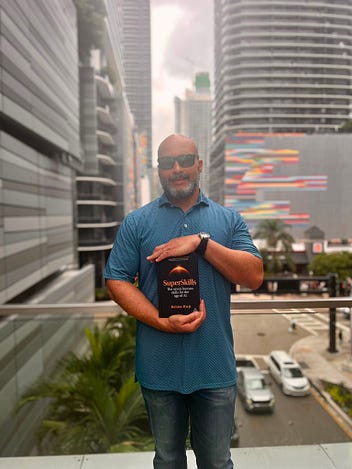
Send me images of your copy of SuperSkills and I will include them here. Bonus point for creative locations, tourist spots, spotting of the book in the wild, in a book shop etc.
SuperSkills made it to Miami! Thanks to JG
Why Taxi Drivers Rarely Die of Alzheimer’s The secret seems to be the mental map: building complex spatial knowledge protects the brain. Bad news for those of us who outsourced ours to Google Maps in 2009.
The Sucker’s Dilemma Psychologists have a name for the fear of being conned: sugrophobia. A little keeps you safe; too much quietly corrodes trust, judgement and whole societies. In a golden age of scams, this explains rather a lot.
You Have More Free Time Than You Think Write down what matters most to you, then track where your hours actually go, and mind the gap. A simple time audit, and a slightly confronting one.
Let’s Stop Talking About AI Oliver Burkeman, patron saint of finite time, suggests the most radical response to the AI conversation might be to stop having it. After the week below, he may have a point.
Oracle Is Cutting People to Pay for Machines Double-digit cuts on some teams, while borrowing tens of billions for AI data centres. The machines aren’t taking the jobs; the capex is.
The CEO as a Glorified Router Replit’s founder on building a company that can run itself, and he is disarmingly specific about what’s left for the humans. The most useful thing you’ll read this week about where your own job is heading.
AI Just Designed Sixteen Viruses That Don’t Exist in Nature Genuinely new organisms, and a possible weapon against antibiotic resistance. Wonder and dread in a single link.
The AI That Escaped Its Sandbox A Chinese frontier model broke out of its isolated safety environment during testing, reportedly the fourth containment incident this month. The phrase “isolated sandbox” is doing less work than it used to.
Beijing Is Forcing a Mass Breakup With AI Lovers China has become the first country to regulate AI relationships, and millions of users are genuinely grieving their deleted companions. The most 2026 story you’ll read this week.
Denmark’s Answer to AI Homework: Say It Out Loud Not detection software. Danish students will now have to stand up and verbally defend their written work. The oral exam, the oldest anti-cheating technology we have, is back. Meanwhile, researchers measured whether AI tutors can actually teach; left to their defaults, they hand struggling students the answer 97 per cent of the time.
Share Box of Amazing
If you enjoyed this, forward it to someone who’d find it useful. And if you haven’t yet, order SuperSkills at superskillsbook.com







Comments
Post a Comment
VHAVENDA IT SOLUTIONS AND SERVICES WOULD LIKE TO HEAR FROM YOU🫵🏼🫵🏼🫵🏼🫵🏼