Hyperliquid: The 11-Person Exchange That Shows How Extreme AI-Era Efficiency Can GetWhat a tiny crypto derivatives team can teach us about the future of AI, agents, and software leverage
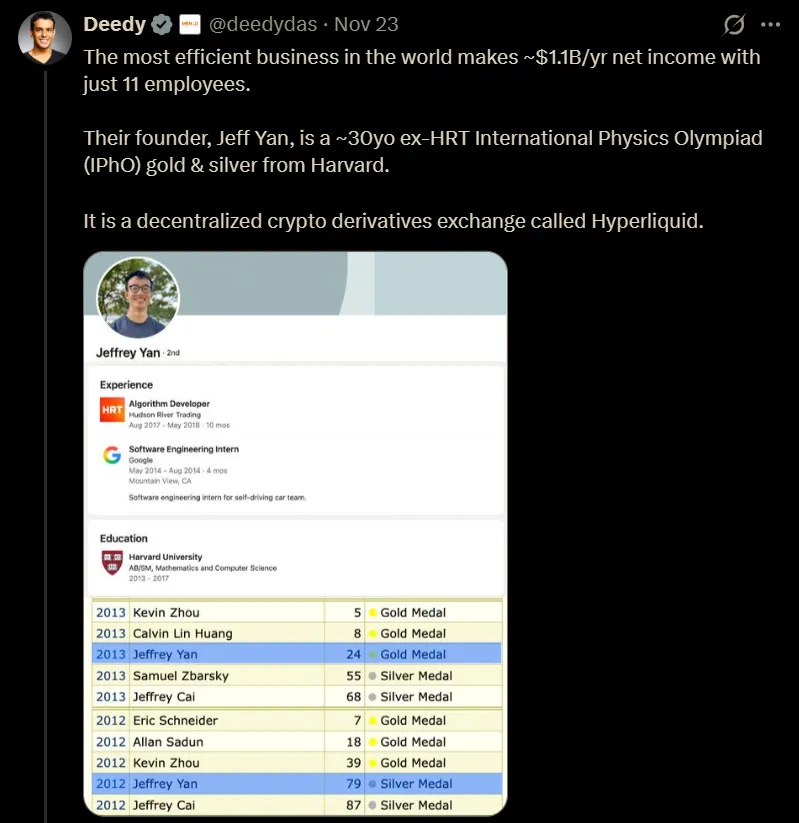
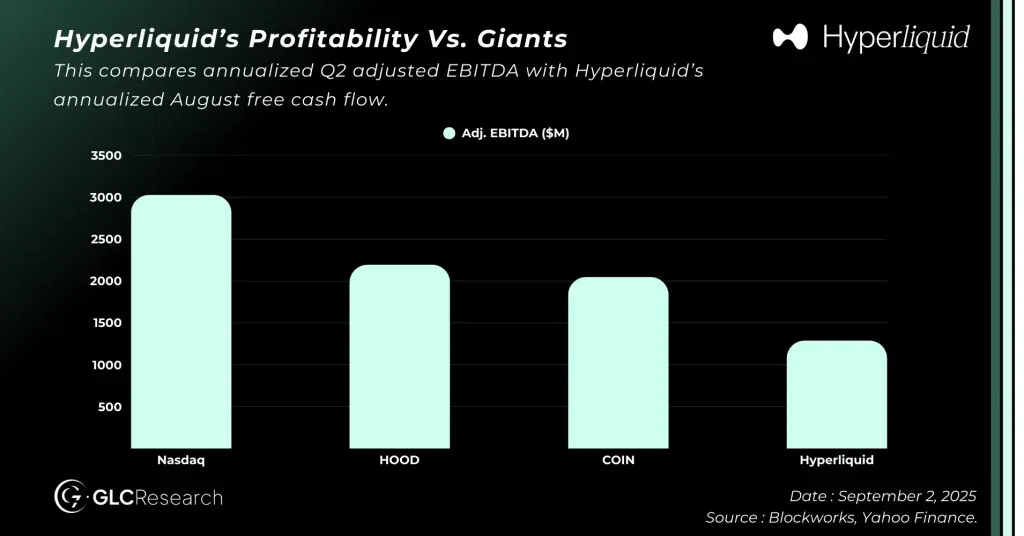
If you want to understand where AI and automation are taking the economy, you do not need a research paper. Hyperliquid is a fully on-chain crypto derivatives exchange running on its own Layer-1 blockchain, with roughly 11 core contributors and about 1.2 billion dollars in annualized protocol revenue.
That works out to around 106 million dollars per person.
Hyperliquid is not marketed as an “AI company,” but it already operates like the kind of AI-native business people keep predicting: a small team, an automated system, and a product that scales without adding humans. In AI terms, it is what happens when you replace departments with code and treat the exchange itself as a giant agent. Let’s break down how it works, where the efficiency comes from, and what it implies for AI founders and investors.
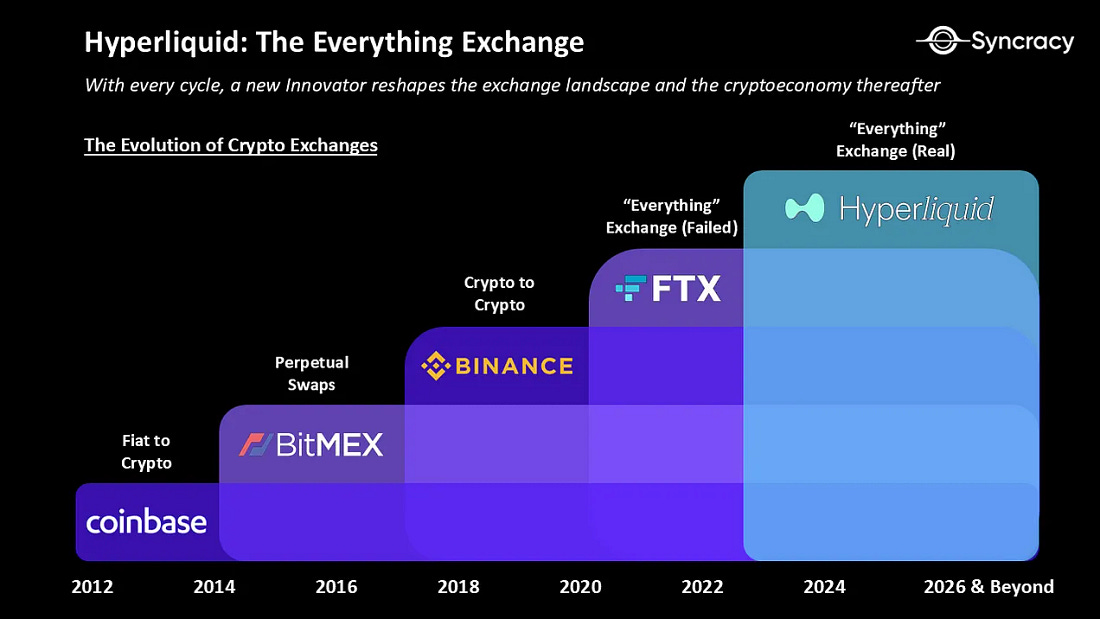
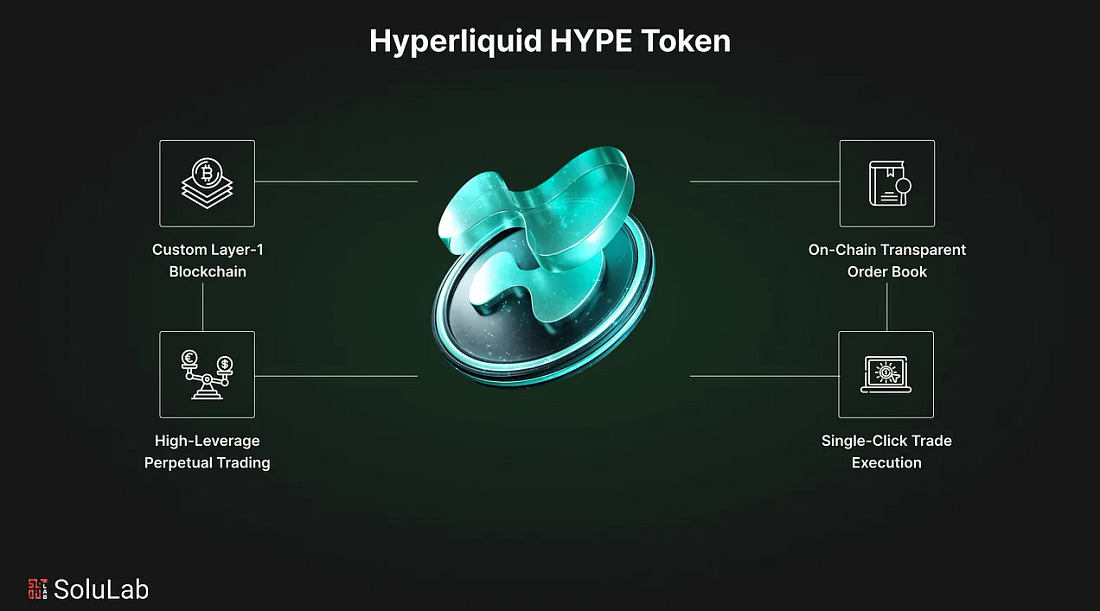
1. Business model: code as the operating teamHyperliquid is a decentralized exchange focused on one product: perpetual futures. It runs a central limit order book (CLOB) on its own Layer-1 and charges a fee on every trade. The model is identical to traditional exchanges like Binance or CME, but almost everything that used to be done by people is now done by software.
There is:
Market makers, funds, and individual traders connect directly to the protocol. The code handles:
As of mid-2025:
Fees flow into:
This is what “software leverage” looks like when you commit to it. The company layer is extremely thin, and almost all of the work is done by a machine. Trading engine and payments rail in oneHyperliquid designed the system around stablecoins. Margin, settlement, and transfers are in USDC, USDT, and similar assets. The L1 is tuned to move stablecoins fast and cheaply. That does two things:
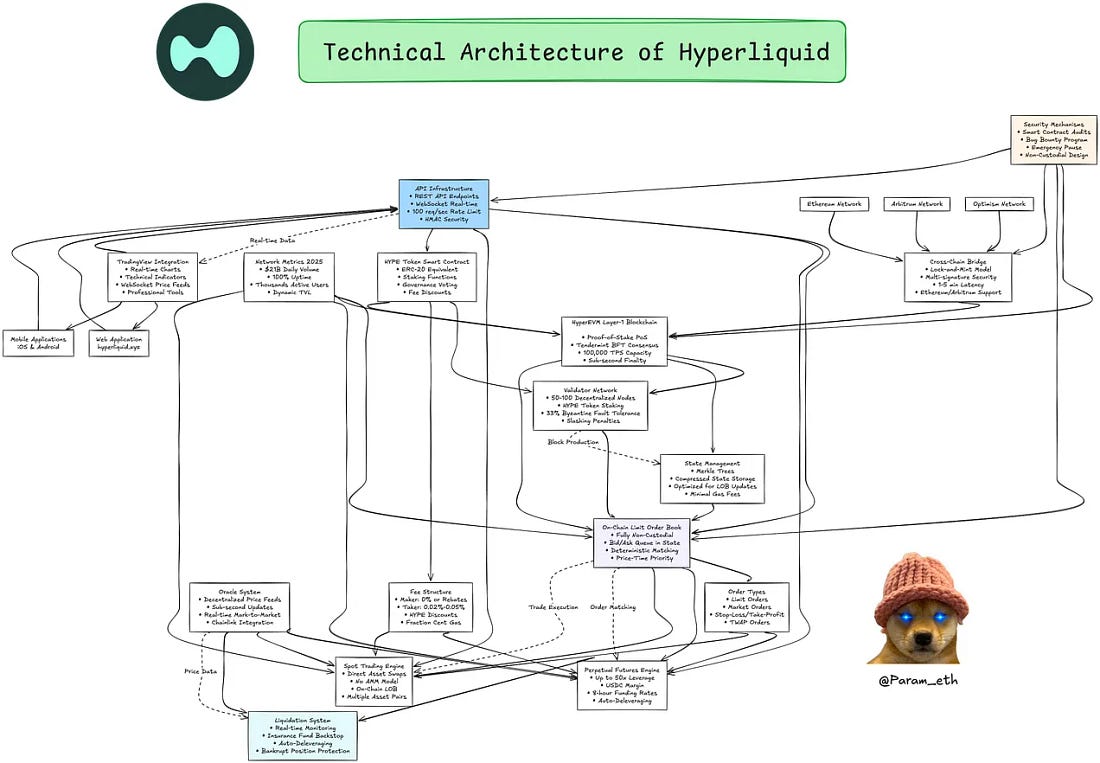
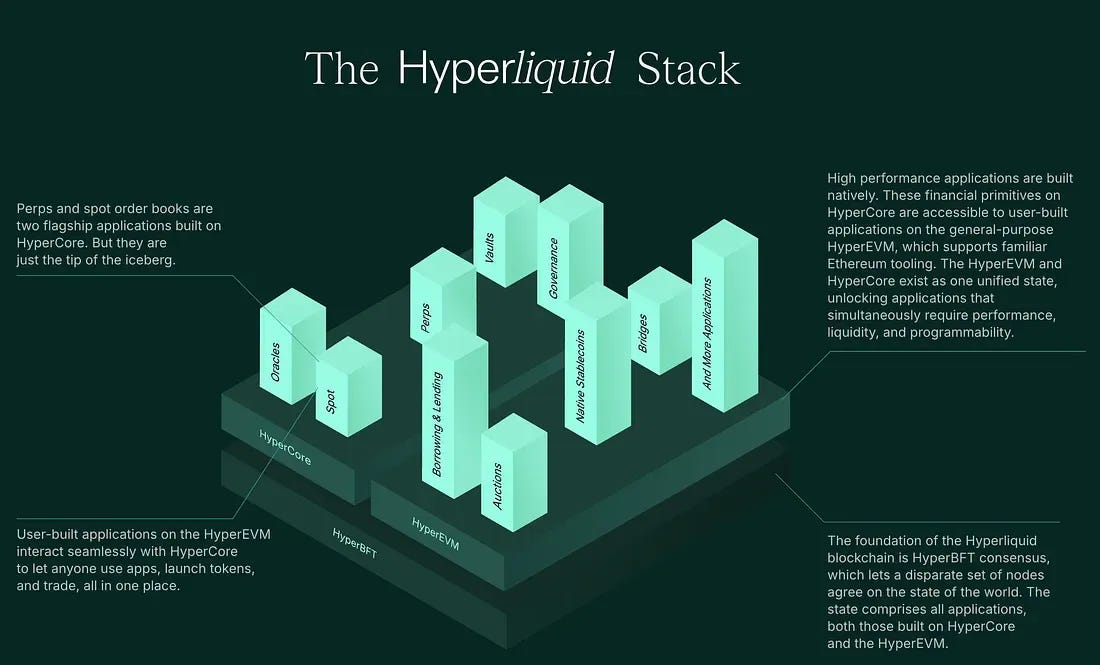
Businesses can hit the APIs and move money globally with near-instant finality, using the same rails that power trading. A chunk of the roughly 330 billion dollars in annual transaction volume is likely non-speculative stablecoin flow riding on this infrastructure. The pitch is simple and powerful: CEX-like performance, DeFi custody, and a programmable payments network, all driven by software, not staff. 2. Technical architecture: a chain that behaves like an AI agent for tradingMost DeFi protocols deploy as smart contracts on a general-purpose chain. Hyperliquid built the chain around the exchange.
Hyperliquid L1, HyperBFT, HyperCoreThe core:
Every order placement, cancel, and trade is a transaction that gets sequenced by consensus and applied by the engine. The blockchain itself is the matching engine and risk system. That brings two key properties:
Reported performance:
From an AI and systems point of view, this looks like a specialized reasoning and execution engine. It ingests a large stream of “actions” (orders), runs them through deterministic logic, and continuously updates a shared world state (positions and balances), with no human in the loop. Gasless UXTraders do not pay on-chain gas for orders. They only pay trading fees on execution. Validators absorb gas costs and are compensated via protocol economics. This design is crucial if you want agents, bots, and quant strategies to hit the chain at high frequency. HyperEVM and ecosystem leverage
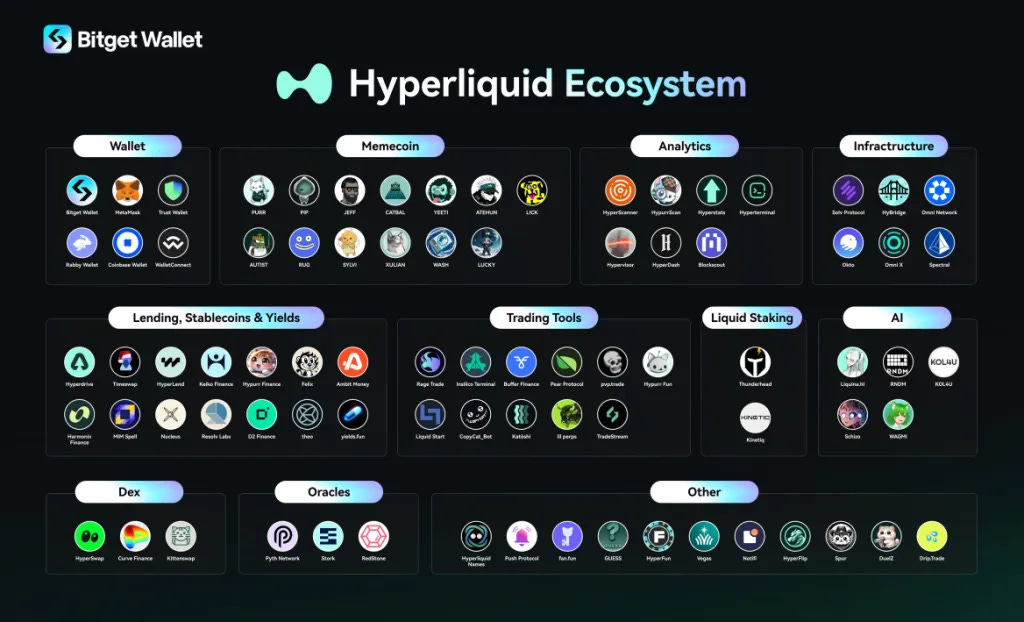
In 2025, Hyperliquid launched HyperEVM, an Ethereum-compatible VM running on the same hardware. Now developers can deploy Solidity contracts into the Hyperliquid environment.
Early examples include:
In AI language, Hyperliquid is turning itself from a single “agent” (the exchange) into a platform for other agents and workflows to live on top of its high-performance state machine. 3. The founder: why Jeff Yan looks like an AI-era archetype
Hyperliquid’s structure mirrors the background of its founder, Jeff Yan.
From HFT, Yan learned how to build ultra-low-latency systems. From Google, he saw how distributed systems scale. From Chameleon, he got capital and an intimate view of market structure across crypto. None of this is directly “AI,” but it is the same profile you see at the core of serious AI infrastructure projects: deep math, strong systems engineering, and domain expertise. Bootstrapped, no VC, community-firstYan funded Hyperliquid with trading profits. There are no venture funds on the cap table. When HYPE launched:
The result is a platform that looks and feels more like infrastructure than a startup chasing a funding milestone. 4. Regulation: automated leverage in a human legal systemHyperliquid’s structure is software-native. Regulation is not. Jurisdiction and accessThe core entities sit in Singapore, with a foundation and affiliated labs. Key facts:
The intent is obvious: operate at global scale while staying out of direct line of fire of U.S. and European derivatives regulations for as long as possible. Enforcement and AML riskChinese authorities have already uncovered money laundering rings that used Hyperliquid’s leverage to move funds. Hyperliquid itself was not charged, but that kind of headline lifts the protocol higher on regulators’ radar. The main structural risks:
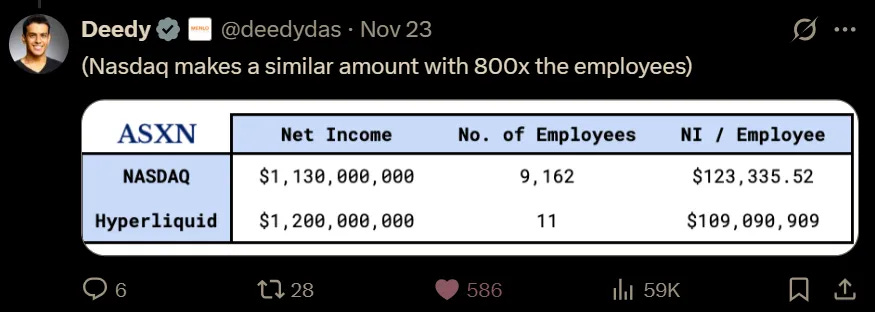
For an AI newsletter readership, the key insight is this: when you compress a billion-dollar operation into a small team and a protocol, you also compress the legal risk onto a tiny group of humans. 5. Hyperliquid vs NASDAQ and Binance: an efficiency benchmark for AI era systemsHyperliquid’s metrics are a useful benchmark for any AI or automation project.
Revenue and margin
Hyperliquid’s costs are so low that most of that revenue would effectively be profit if it were a traditional company. Revenue per employee
If you are thinking about AI efficiency, this is the number to focus on. Hyperliquid is what a fully automated, software-led financial system looks like when it works. 6. Industry reaction: “proof of concept” or “centralized risk in disguise”?AdmirationSupporters see Hyperliquid as proof that DeFi and automation can finally challenge centralized exchanges on their own turf. They point to:
For traders, Hyperliquid feels like Binance. For DeFi purists, it is at least closer to the trust model they want. SkepticismCritics raise three issues:
For the AI community, the takeaway is not who is right. It is that once you show what a hyper-efficient, code-only financial system looks like, you force the entire industry to react, including regulators and competitors. 7. Sustainability: is Hyperliquid a new pattern or a one-off?Hyperliquid’s model comes with obvious questions. Market and cycle riskPerp volume is volatile. In a deep bear market, fee revenue can collapse. Hyperliquid is still concentrated in a single line of business. The payments and settlement narrative could stabilize this if more real-economy flows move across its stablecoin rails. Competitive risk
Hyperliquid’s real moat rests on:
Regulatory and operational riskA serious regulatory move could change the economics overnight. Over time, Hyperliquid will probably have to trade some of its extreme lean structure for more resilience: a bigger team, open-source clients, more decentralized validation, better governance. What Hyperliquid tells us about AI and the future of workHyperliquid is not marketed as an AI product, but it behaves like one:
It is a real-world example of what people mean when they talk about AI agents, autonomous systems, and software leverage. For founders building in AI:
For investors:
Hyperliquid may or may not remain the most profitable exchange in the world. In the age of AI, that is the real story.
|
Hyperliquid: The 11-Person Exchange That Shows How Extreme AI-Era Efficiency Can Get







Posted by WE BRING YOU THE BEST!
 VHAVENDA I.T SOLUTIONS


0 Comments
VHAVENDA IT SOLUTIONS AND SERVICES WOULD LIKE TO HEAR FROM YOU🫵🏼🫵🏼🫵🏼🫵🏼