Is your team building or scaling AI agents?(Sponsored)
One of AI’s biggest challenges today is memory—how agents retain, recall, and remember over time. Without it, even the best models struggle with context loss, inconsistency, and limited scalability. This new O’Reilly + Redis report breaks down why memory is the foundation of scalable AI systems and how real-time architectures make it possible. Inside the report:
Disclaimer: The details in this post have been derived from the details shared online by the Databricks Engineering Team. All credit for the technical details goes to the Databricks Engineering Team. The links to the original articles and sources are present in the references section at the end of the post. We’ve attempted to analyze the details and provide our input about them. If you find any inaccuracies or omissions, please leave a comment, and we will do our best to fix them. Kubernetes has become the standard platform for running modern microservices. It simplifies how services talk to each other through built-in networking components like ClusterIP services, CoreDNS, and kube-proxy. These primitives work well for many workloads, but they start to show their limitations when traffic becomes high volume, persistent, and latency sensitive. Databricks faced exactly this challenge. Many of their internal services rely on gRPC, which runs over HTTP/2 and keeps long-lived TCP connections between clients and servers. Under Kubernetes’ default model, this leads to uneven traffic distribution, unpredictable scaling behavior, and higher tail latencies. By default, Kubernetes uses ClusterIP services, CoreDNS, and kube-proxy (iptables/IPVS/eBPF) to route traffic:
Since the selection happens only once per TCP connection, the same backend pod keeps receiving traffic for the lifetime of that connection. For short-lived HTTP/1 connections, this is usually fine. However, for persistent HTTP/2 connections, the result is traffic skew: a few pods get overloaded while others stay idle. For Databricks, this created several operational issues:
The Databricks Engineering Team needed something smarter: a Layer 7, request-level load balancer that could react dynamically to real service conditions instead of relying on connection-level routing decisions.
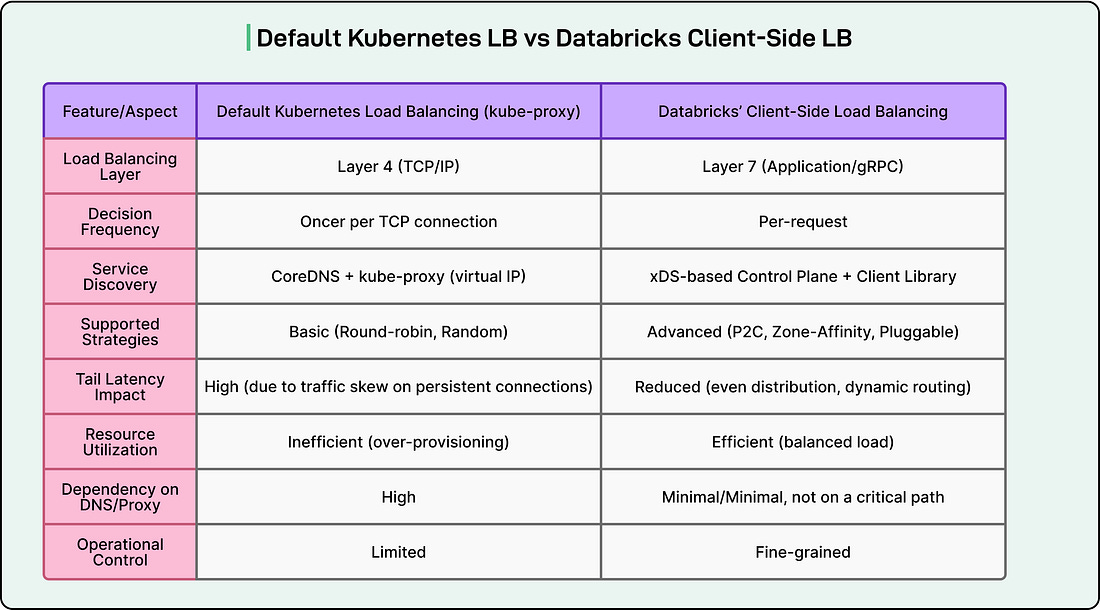
In this article, we will learn how they built such a system and the challenges they faced along the way. The Core SolutionTo overcome the limitations of the default Kubernetes routing, the Databricks Engineering Team shifted the load balancing responsibility from the infrastructure layer to the client itself. Instead of depending on kube-proxy and DNS to make connection-level routing decisions, they built a client-side load balancing system supported by a lightweight control plane that provides real-time service discovery. This means the application client no longer waits for DNS to resolve a service or for kube-proxy to pick a backend pod. Instead, it already knows which pods are healthy and available. When a request is made, the client can choose the best backend at that moment based on up-to-date information. Here’s a table that shows the difference between the default Kubernetes LB and Databricks client-side LB:
By removing DNS from the critical path, the system gives each client a direct and current view of available endpoints. This allows smarter, per-request routing decisions instead of static, per-connection routing. The result is more even traffic distribution, lower latency, and better use of resources across pods. This approach also gives Databricks greater flexibility to fine-tune how traffic flows between services, something that is difficult to achieve with the default Kubernetes model. Custom Control Plane - Endpoint Discovery ServiceA key part of the intelligent load balancing system is its custom control plane. This component is responsible for keeping an accurate, real-time view of the services running inside the Kubernetes cluster. Instead of depending on DNS lookups or static routing, the control plane continuously monitors the cluster and provides live endpoint information to clients. See the diagram below: 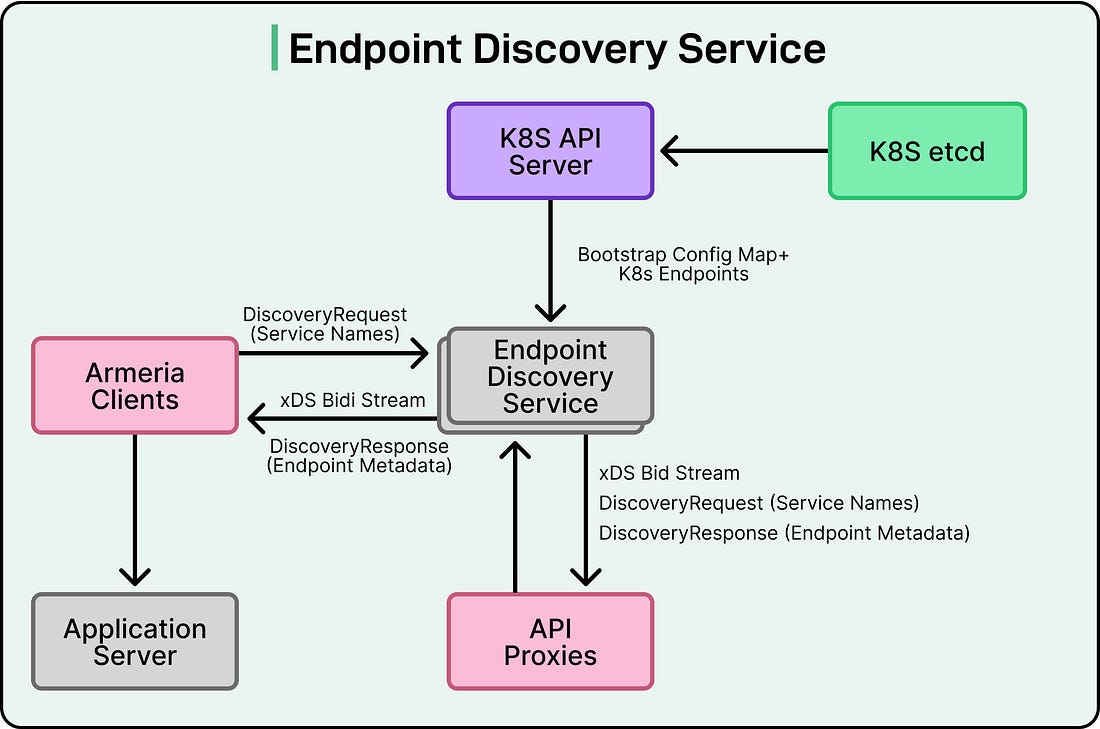 Here is how it works:
This design has several benefits:
Client Integration with RPC FrameworksFor any load-balancing system to work at scale, it has to be easy for application teams to adopt. Databricks solved this by directly integrating the new load-balancing logic into their shared RPC client framework, which is used by most of their internal services. Since many Databricks services are written in Scala, the engineering team was able to build this capability once and make it available to all services without extra effort from individual teams. Here is how the integration works:
Advanced Load Balancing StrategiesOne of the biggest advantages of the client-side load balancing system at Databricks is its flexibility. Since the routing happens inside the client and is based on real-time data, the system can use more advanced strategies than the basic round-robin or random selection used by kube-proxy. These strategies allow the client to make smarter routing decisions for every request, improving performance, reliability, and resource efficiency. Power of Two Choices (P2C)The Power of Two Choices algorithm is simple but powerful. When a request comes in, the client:
This approach avoids both random traffic spikes and overloaded pods. It balances traffic more evenly than round-robin while keeping the logic lightweight and fast. Databricks found that P2C works well for the majority of its services. Zone-Affinity RoutingIn large, distributed Kubernetes clusters, network latency can increase when traffic crosses zones. To minimize this, the team uses zone-affinity routing:
Pluggable StrategiesThe architecture is designed to be extensible. The team can easily add new load-balancing strategies without changing the overall system. For example:
xDS Integration with Envoy for Ingress TrafficThe Databricks Engineering Team didn’t limit its intelligent load balancing system to internal traffic. They also extended their Endpoint Discovery Service (EDS) control plane to work with Envoy, which manages external ingress traffic. This means that both internal service-to-service communication and traffic coming into the cluster from outside follow the same set of routing rules. Here’s how this works:
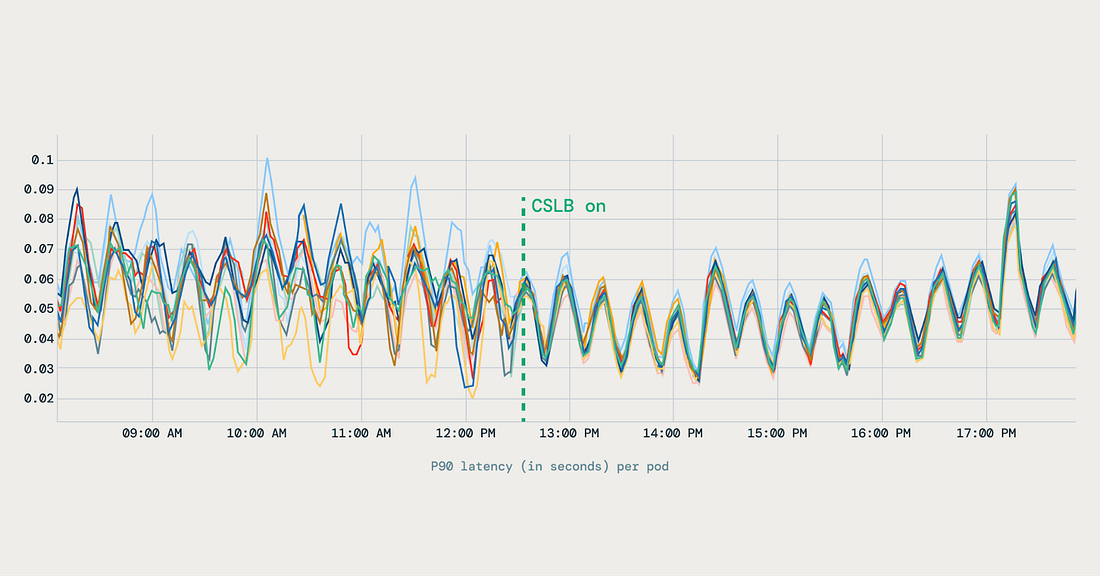
ConclusionThe shift to client-side load balancing brought measurable benefits to Databricks’ infrastructure. After deploying the new system, the traffic distribution across pods became uniform, eliminating the issue of a few pods being overloaded while others sat idle. This led to stable latency profiles, with P90 and tail latencies becoming much more predictable, and a 20 percent reduction in pod count across multiple services.
The improved balance meant Databricks could achieve better performance without over-provisioning resources. The rollout also surfaced some important lessons:
Looking ahead, Databricks is working on cross-cluster and cross-region load balancing to scale this system globally using flat L3 networking and multi-region EDS clusters. The team is also exploring advanced AI-aware strategies, including weighted load balancing for specialized backends. These future improvements are aimed at handling even larger workloads, supporting AI-heavy applications, and maintaining high reliability as their platform grows. Through this architecture, Databricks has demonstrated a practical way to overcome the limitations of the default Kubernetes load balancing and build a flexible, efficient, and scalable traffic management system. References: SPONSOR USGet your product in front of more than 1,000,000 tech professionals. Our newsletter puts your products and services directly in front of an audience that matters - hundreds of thousands of engineering leaders and senior engineers - who have influence over significant tech decisions and big purchases. Space Fills Up Fast - Reserve Today Ad spots typically sell out about 4 weeks in advance. To ensure your ad reaches this influential audience, reserve your space now by emailing sponsorship@bytebytego.com.
|
How Databricks Implemented Intelligent Kubernetes Load Balancing





Posted by WE BRING YOU THE BEST!
 VHAVENDA I.T SOLUTIONS


![[Happening Next Week!] From Silence to Disclosure: Rethinking the Measurement of Intimate Partner Violence](https://lh3.googleusercontent.com/blogger_img_proxy/AEn0k_tiCDEZKFsbNxSXVYecFqtZCx3ZW_XnCksXfofSr6Luxo-LICHMFJEKq_Y0RWeiNhzBcm8_fEoqOEA68Jszr2SaekXb9tp18o9TqQMG6JN4RozE0NQyF1LCtCia1haFUf4bumDKANUCCaB14aQeGX0l_zIAcEji_nDtQ3gKOTO8TEz1S7qipkgYUTUTcrEbVpS3Pzdu3AXM1dC3tqZP4J7Wx5LkGzofEIv8ofsDqyVPeA=w72-h72-p-k-no-nu)


0 Comments
VHAVENDA IT SOLUTIONS AND SERVICES WOULD LIKE TO HEAR FROM YOU🫵🏼🫵🏼🫵🏼🫵🏼