 Hamlin Area UDSA Service Center September Update - September 23, 2025 In This Issue: We have received several calls about the drought, and we are closely monitoring the ongoing drought in our counties, as of the drought monitor that was released on Thursday, September 18, 2025, the following counties are still in D1 (Moderate Drought) conditions, Boone, Logan, Mingo and Wayne. Cabell and Lincoln are in D2 (Severe Drought) conditions. To be eligible to run the Livestock Forage Program (LFP) and the Emergency Livestock Assistance Program (ELAP) that we ran last year for the drought conditions our counties must be in the D2 designation for 8 consecutive weeks, or in the D3 designation for 1 week. The drought monitor is released every Thursday Morning, and we are checking it to stay up to date on the status of the drought in our area. You can check it yourself at the following website. https://droughtmonitor.unl.edu/ If you have any questions feel free to contact us here in the office and speak with Tiffany or myself. You can reach us at (304) 824-3236. 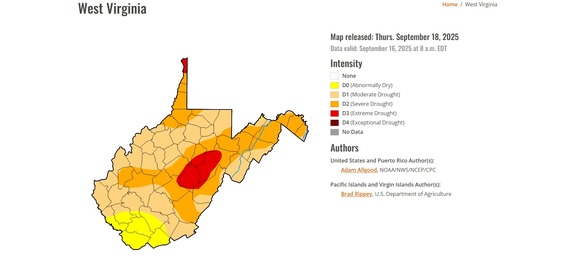  USDA is reducing red tape around the Natural Resources Conservation Service (NRCS) and National Environmental Policy Act (NEPA)-related reviews, which will improve conservation delivery to America's farmers and ranchers. NEPA requires all federal agencies to consider the environmental impact of their proposed actions before deciding whether and how to proceed. NEPA's aims are to ensure that agencies consider the potential environmental effects of their proposed actions in their decision-making processes and encourage public engagement in that process. To comply with NEPA, agencies determine the appropriate level of review for a proposed action. Where required, these levels of review may be documented in an environmental impact statement (EIS), an environmental assessment (EA), or categorical exclusion. A federal agency may establish categorical exclusions — categories of actions that the agency has determined normally do not significantly affect the quality of the human environment — in its agency NEPA procedures. Notice with Revised Guidelines The notice describes the categories of proposed actions for which NRCS intends to apply the categorical exclusions, the considerations that NRCS will use in determining the applicability of the categorical exclusions and the consultation between the agencies on the use of the categorical exclusions, including application of extraordinary circumstances. The notice is available at the NRCS NEPA website under the "NRCS NEPA Regulations, Guidance, and Related Documents." | Top of page  Livestock inventory records are necessary in the event of a natural disaster, so remember to keep them updated. When disasters strike, the USDA Farm Service Agency (FSA) can help you if you've suffered excessive livestock death losses and grazing or feed losses due to eligible natural disasters. For 2025 losses through the Livestock Indemnity Program (LIP) and Emergency Assistance for Livestock, Honeybees, and Farm-raised Fish Program (ELAP), you must file a notice of loss, provide the following supporting documentation, and application for payment to your local FSA office by March 2, 2026. You should record all pertinent information regarding livestock inventory records including: - Documentation of the number, kind, type, and weight range of livestock
- Beginning inventory supported by birth recordings or purchase receipts.
For more information on documentation requirements, contact your Hamlin Area USDA Service Center at (304) 824-3236 or visit fsa.usda.gov. | Farmers can use USDA farm ownership microloans to buy and improve property. These microloans are especially helpful to beginning or underserved farmers, U.S. veterans looking for a career in farming, and those who have small and mid-sized farming operations. Microloans have helped farmers and ranchers with operating costs, such as feed, fertilizer, tools, fencing, equipment, and living expenses since 2013. Microloans can also help with farmland and building purchases and soil and water conservation improvements. FSA designed the expanded program to simplify the application process, expand eligibility requirements and expedite smaller real estate loans to help farmers strengthen their operations. Microloans provide up to $50,000 to qualified producers and can be issued to the applicant directly from the USDA Farm Service Agency (FSA). To learn more about the FSA microloan program, contact your Mason County USDA Service Center at (304) 675-2020 or visit fsa.usda.gov/microloans. Top of page 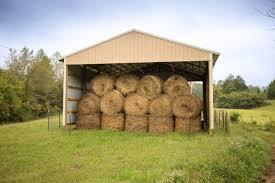 | | The Farm Service Agency's (FSA) Farm Storage Facility Loan (FSFL) program provides low-interest financing to help you build or upgrade storage facilities and to purchase portable (new or used) structures, equipment and storage and handling trucks. Eligible commodities include corn, grain sorghum, rice, soybeans, oats, peanuts, wheat, barley, minor oilseeds harvested as whole grain, pulse crops (lentils, chickpeas and dry peas), hay, honey, renewable biomass, fruits, nuts and vegetables for cold storage facilities, controlled atmosphere storage, floriculture, hops, malted small grains, maple sap, maple syrup, rye, milk, cheese, butter, yogurt, meat and poultry (unprocessed), eggs, and aquaculture (excluding systems that maintain live animals through uptake and discharge of water). Qualified facilities include grain bins, hay barns and cold storage facilities for eligible commodities. Loans up to $50,000 can be secured by a promissory note/security agreement, loans between $50,000 and $100,000 may require additional security, and loans exceeding $100,000 require additional security. You do not need to demonstrate the lack of commercial credit availability to apply. The loans are designed to assist a diverse range of farming operations, including small and mid-sized businesses, new farmers, operations supplying local food and farmers markets, non-traditional farm products, and underserved producers. For more information, contact your Hamlin Area USDA Service Center at (304) 824-3236 or visit fsa.usda.gov/pricesupport. | Top of page Hamlin Area USDA Service Center 8150c Court Ave
Hamlin, WV 25523 Phone: 304-824-3236 Service Center Locator FSA County Executive Director, Andrew "Drew" Asbury - Andrew.Asbury@usda.gov FSA Farm Loan Trainee, Katie Winterstein - Katlynne.Winterstein@usda.gov NRCS District Conservationist, Corine Powell - corine.powell@usda.gov Hamlin Area Farm Service Agency County Committee Tanner Ekers, Wayne County - Chairperson
Elmer Aleshire Jr., Boone County - Vice Chairperson
Joe Ware, Lincoln County - Regular Member
Carl E. McCoy, Lincoln County - Regular Member
Tracy L. Vickers, Lincoln County - Regular Member
Barbara Varner, Logan/Mingo Counties - Regular Member
Wyvonna "Mitzi" Winters, Cabell County - Regular Member
Adam D. Midkiff, Cabell County - Regular Member
Shayla Lucas, Cabell County - Regular Member
Myrtle A. Perry, Wayne County - Regular Member | |









0 Comments
VHAVENDA IT SOLUTIONS AND SERVICES WOULD LIKE TO HEAR FROM YOU🫵🏼🫵🏼🫵🏼🫵🏼