Here are the facts:
Our work is better than it was five years ago. (We were recently awarded the David Nyhan Prize for Public Policy Journalism by Harvard’s Shorenstein Center.) But the billionaires who control Google, Facebook, and X have made the decision to choke off traffic to independent outlets like Popular Information. They are not interested in building an audience for stories like the one you are about to read. This means that in order to survive, we need to decouple our success from the whims of tech oligarchs. That will require investing in new ways to spread the word about our journalism. To do this, we need your help. If just a small percentage of free subscribers like you upgrade to a paid subscription ($50/year or $6/month), we can expand our reach and magnify our impact. Thank you for your readership and consideration. — Judd The hidden dangers of Musk’s votesafe.orgThe slick voter registration website, currently being promoted to millions of people, is a digital surveillance machine.
With the midterm elections approaching, it’s a good idea to make sure you are registered. Each state has a tool to do so, and the federal government has set up a page that directs you to the right place, vote.gov. Vote.gov, which is run by the Election Assistance Commission (EAC), does not ask for your personal information or track your activities. According to the site’s privacy policy, the EAC “does not collect personally-identifiable information about you when you visit our site, unless you choose to provide such information to us.” The exception to the policy is very limited. For example, if you email the EAC requesting information, they will retain your email address so they can send a response. Further, the EAC does not track your internet activity. “No cookies used by EAC ever store any information that may be used to identify you personally,” the commission’s privacy policy says. But Elon Musk, the world’s richest person, is funding an aggressive advertising campaign encouraging people in key states to check their registration status at a different website, votesafe.org. That website is run by America PAC, Musk’s super PAC. While Vote.gov collects no personal information, votesafe.org collects the following:
Previously, votesafe.org had a privacy policy that provided some limitations on how America PAC could use this data:
On August 29, 2026, the privacy policy was updated and no longer includes that language. The new version allows America PAC to “share” or “sell” personal information with “our business partners.” This includes selling information about “whether you are registered to vote” and “how you submit your vote… where permitted by law.” In addition to selling your personal information, America PAC can also sell “inferences” it makes from the information it collects including “psychological trends, predispositions, behavior, attitudes, intelligence, abilities and aptitude.” The “business partners” can then disclose your information to other parties. You also agree to receive calls and texts, not only from America PAC, but also from “related entities as well as third parties.” Votesafe.org is currently configured to share your information with numerous partners and to let advertising companies comprehensively track you across websites, apps, and streaming services. As you visit votesafe.org:
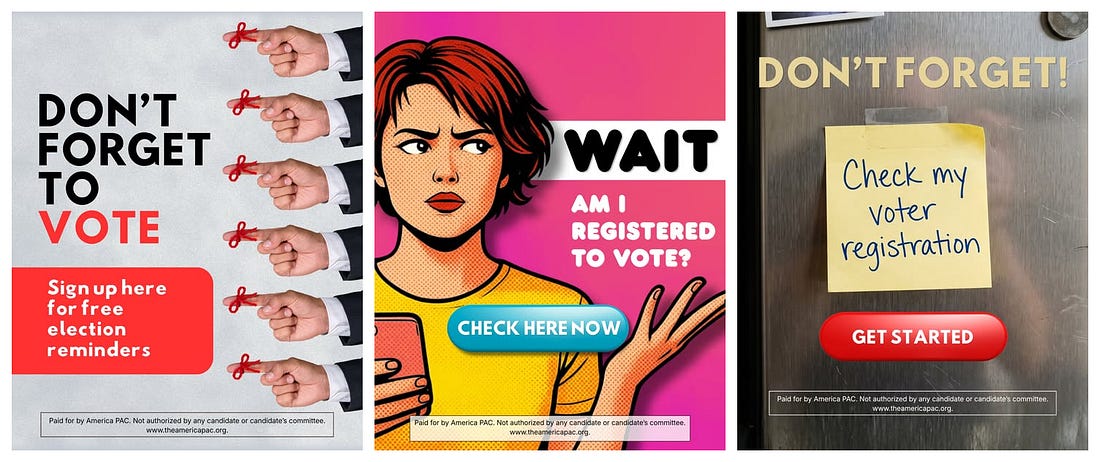
Over the last week alone, America PAC has spent over $180,000 promoting votesafe.org on Meta. Some of the ads are innocuous-looking messages, just reminding people to vote:
Other Meta ads attack “socialists” or specific Democratic senate candidates with incendiary messages:
On Sunday, America PAC also launched YouTube ads attacking Democratic candidates. Nearly all of these ads promote VoteSafe.org at the end.
Overall, Musk has pledged to spend over $100 million in the midterm elections, focusing on turnout. The data collected through votesafe.org looks to be central to this effort. Votesafe.org is not just a website but a platform that can be white-labeled by Musk’s ideological allies. The data is then sent to America PAC’s servers. Sentinel Action Fund, the Super PAC affiliated with the Heritage Foundation, used votesafe.org to create its own voter registration site — register.sentinelactionfund.com. Sentinel Action Fund then spent $650,000 on advertising that promoted the site and defended Trump’s presidency during Fox News’ coverage of the State of the Union. Jessica Anderson, the president of Sentinel Action Fund, said the new site made registration “easier” and ensured “voter information isn’t going into the hands of extremist Democrat organizations.” Sentinel Action Fund’s connection to Musk’s votesafe.org has not been previously reported. Votesafe.org also powers the registration site of another organization, Ready to Register. In North Carolina, the State Board of Elections reported Ready to Register “sent mailings to an unknown number of citizens with an outdated voter registration application which includes four political parties that are no longer recognized in North Carolina.” The North Carolina Board of Elections also “received reports that mailings are being sent to deceased individuals and that the group may be using outdated voter data.” Further, “QR codes on the mailings may cause information from other people to pre-populate on a form, which has raised privacy concerns among voters.” In July, the Washington Post reported that the source code of Ready to Register’s website “links to another group affiliated with Musk’s political outfit, America PAC.” If you have a news tip, please contact us via Signal at juddlegum.47. We will maintain your anonymity. Please check out Popular Information’s sister publication Oligarch Watch. The same accountability journalism, laser-focused on the world’s wealthiest people. Subscribe HERE.
|