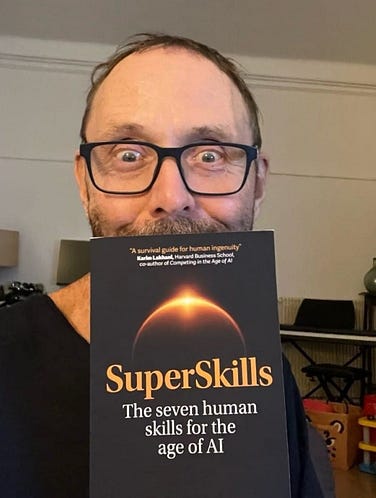
Box of Amazing: A weekly essay on human capability in the age of AI. By Rahim Hirji, author of SuperSkills (out July 2026). Pre-order the book at superskillsbook.com My book SuperSkills: The Seven Human Skills for the Age of AI is available at all good bookstores, through superskillsbook.com or on Amazon. Please review if you have read it! Also available at 40% off at Koganpage.com globally this weekend only.I work with organisations and leadership teams on SuperSkills, human capability, and AI-era decision-making through speeches, workshops, keynotes and advisory work. In person or virtual. UK, Europe, global. → Book a discovery call | → Explore: thesuperskills.com
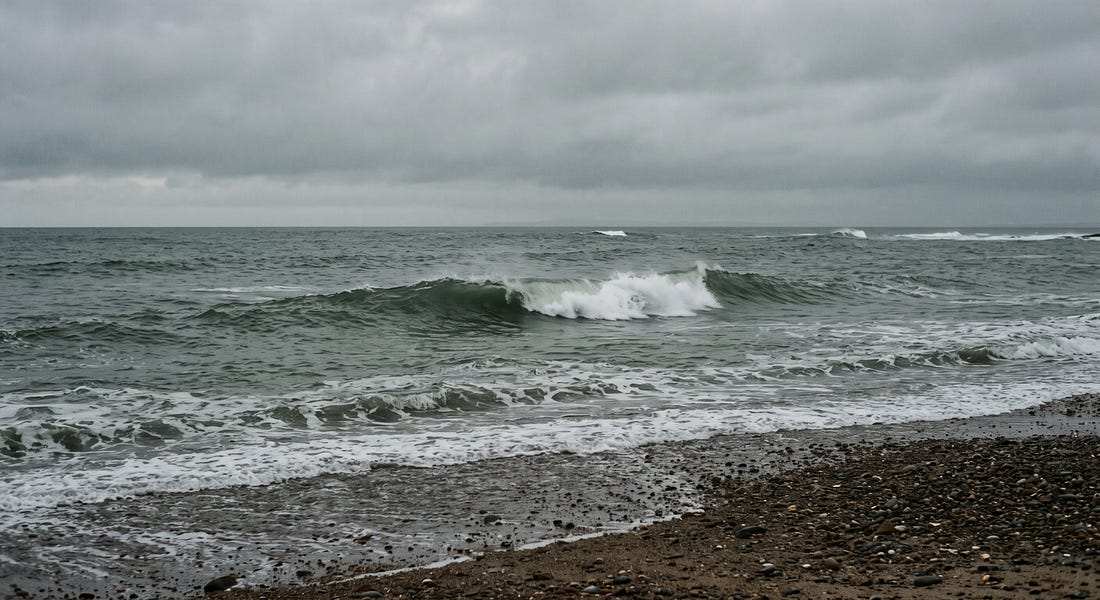
NB: I found this incredibly tough to write. You might find it tough to read. Friends, The last time we spoke, my friend told me that he reads this newsletter every weekend. I joked that nobody really does, that on average people read one a month, or skim. He said no, I promise, I read every one. Every single one. I believed him. A few weeks ago an ex-colleague and mutual friend messaged me, checking that I knew he had passed away. I read the message twice, didn't believe it, and then did something I never do. I rarely look at the statistics for this newsletter. I write it, I send it, and I let it find whoever it finds. That day I opened the dashboard and looked. He had been telling the truth. Seven years of Sundays, every single one opened since he signed up. The record stops on the week he died. A machine reading that data would file it under churn. It would see a lapsed subscriber, a line in a spreadsheet, a candidate for a win-back campaign. I read it and I knew it was true. We were looking at the same number, the machine and I, and only one of us understood what it measured. The message had come on WhatsApp. Others found out from a tribute his wife posted on Instagram. This is the way of the world now. We are dispersed and transient, and so the news reaches us as a transaction, a notification between other notifications, telling us that someone has checked out of this life and is, we hope, at peace in whatever comes next. When I had finished with the numbers and the initial shock, I messaged his wife, and she replied straight away to say she had been trying to find me. And I wondered - how do you tell everyone? It was not the first time I had learnt of a death this way. I suspect it will not be the last. The goodbye was at a crematorium in North Oxford. The older you get, the more of these you attend, and I have still never worked out the rules. Nobody teaches you when to stand, when to bow your head, whether you are allowed to laugh. You learn it by watching the person beside you, half a second before you need to know. These services have become celebrations now, less a goodbye than an account of who someone was and what they left in other people. The strange thing about them has not changed. You walk in half expecting to see the person, because every other gathering of these particular people would have had them at the centre of it. I had not seen my friend in person for a couple of years. Some part of me was still sad not to find him in the room, which is the surest sign of how the mind resists this news. And his photo at the front of the room was the realisation that he wasn’t going to make it this time. We sang Jerusalem. I am not a Christian, but a school made me sing it for years in the eighties, and the words are still in me, so I didn’t even look at the sheet that was shared. The second verse begins, bring me my bow of burning gold, and I knew it was coming before it came, weirdly engrained in my brain, every word of a hymn from a faith that has never been mine. My friend would have found that funny. I spend these celebrations of life trying as much as I can not to listen. I fix my eyes on the person in front, or on the flowers, or my feet, and I let the words blur at the edges, because I have learnt what happens when I let them in. I have broken down before, uncontrollably, in a room full of people who were all holding themselves together, and once it has happened to you, you spend every service afterwards guarding the door. That day, there was a joke about British men and their emotional range. It got a laugh because it was true of most of us males in the room. I wrote a book about being human. And in the room where human attention matters most, I rationed mine. I am not proud of that. I suspect I am not alone in it either. And yet, tears did flow. A machine has no such problem. It can attend to every word of a eulogy, because nothing it hears can break it. What it has never once had to do is look away. His son played the piano. He had taught himself, we were told, so that he could play this one piece properly on this one day. It was Satie, the first Gymnopédie, one of those slow pieces that self-taught pianists reach for because it forgives a learner’s hands while holding more beauty than its simplicity suggests. He introduced it with a joke, and the timing of it was his father’s exactly, the same joviality, the same delivery. Then he played it slowly and properly, and there was something in his shoulders as he played that made the whole room go still. Later, at the wake, it was his son who told me afterwards that the Gymnopédie sounds like something from Minecraft - and why it was strangely nostalgic for him - and he said it with his father’s dry humour. My friend’s brother spoke next, with stories reaching back to boyhood, and between the brother’s speech and the sister’s reading, the room heard from the two people who grew up with him and knew him the longest. His sister read Maya Angelou, the poem about what happens when great trees fall, the one that says the dead existed, and that because they existed, we can be better. I have heard that poem before. It breaks me every time. Read in the voice of a sister, it is a different poem from the one on the page. Then his daughter stood up. She spoke about love and about loss, about the graduation he will now not see and the aisle he will not walk her down, and she told us he was brave. She said that he had mustered himself to be there for her even when he was not okay. She called her father brave, and I think every person in that room was watching her and thinking the same word about her. Afterwards, at the wake, there were pockets. A pocket of family, a pocket of friends collected across decades, a pocket of colleagues, including people who had joined the firm because he hired them and stayed because of who he was. The pockets traded stories, and the stories assembled a man none of us had known in full. I won’t describe him to you. Anything I write would be my version of him, and my version was one of many who turned up that day, and none of them was the whole man. A relationship with anyone is never quite complete. We met as colleagues, and somewhere in the years of working together we became friends, though I do not think either of us ever said so out loud. He called me Rahimio instead. He had for years, and I had assumed it was simply what he did, a funny name for everyone. It turns out not everyone had one. Nobody else has ever called me that, and I do not know why he chose it, or when. I suspect it started while we were still working together, and only in private, and he kept it up every time we spoke. I guess that made me his friend. I just didn’t realise it. I have been turning over what a relationship with a person actually is. Whether it is who they were, or the version of them you knew, or the legacy they leave behind. All of those are true at once. But there is a fourth answer I had never considered, which is who they knew you to be, and you may not find that out in time. Standing in the car park of a crematorium in North Oxford, I found out too late. His wife said to me, I am sorry for your loss. She said it to others too, and it was the most fitting thing said all day. Condolences are meant to flow towards the closest, and she had turned them around, because she understood that everyone in that room had lost a version of him that was theirs alone. Every friendship keeps an archive that only two people hold, the jokes that need no setup, the day that went wrong in a way you could never explain to anyone who wasn’t in the room. When one of the two dies, the archive passes to a single keeper. I can no longer check any of it against him. Some of what we lived through together I now remember alone, and I have already caught myself wondering whether I am remembering it right. It is a smaller grief inside the big one, and nobody warns you about it. In the days after the news, I went back to our messages. We had been due to speak, and he had cancelled, and cancelled again, and he told me that life was tough. I replied that I was there to talk. He never answered, and I never followed up. I scrolled to the top of the thread and read all of it, top to bottom, and then I reached the end again, where the last message is mine, still waiting. Maybe I should have followed up? Maybe it would have changed nothing? I will never know. Somewhere between the piano and the poem, my guard had given way, and the words came in, and they did what I had always feared they would. So since that day I have gone looking for the people who found language for this, because I needed it, and I think you might too. And if not now, then you will, I’m afraid, one day. The wisest thing I have ever read about grief was written by a stranger on the internet. I found it four years ago, when my mentor and dear friend died, and I had to experience grief properly for the first time. In a comment thread, an older man wrote to someone newly bereaved and described grief as waves. At the start the waves are enormous and they arrive without warning, and all you can do is hold on to whatever floats. In time they come further apart, and you begin to see them forming in the distance, a date, a song, a slow piece of piano music, and although they still knock you down, you learn that you come back up. It matters to me that this was a comment on a feed. The same kind of feed that told me my friend was gone. The place where we now learn who has left the world is also the place where a stranger taught millions of us how to keep living in it. Nick Cave, who has buried two sons and answers letters from grieving strangers, has written that loss, given time, made him larger. He became more porous to other people, more available to them, more easily reached. I hate Instagram but I watched his wife’s tribute thirty times. I understand now that I was checking, each time, whether the news was still true. It was still true all thirty times, and some part of me pressed play again anyway. The past tense has to be learnt, verb by verb, and it does not stay learnt until you are ready to say goodbye. You may never be. We say gone but never forgotten. We mean it completely when we say it, and then, in the ordinary traffic of living, we forget. We forget more than we would ever admit at a funeral. And I have come to believe the forgetting is survivable, because remembering was never where he lived. The people we grieve become part of who we are. They live in the timing of a joke, in a nickname you learnt too late, in something in the shoulders of a boy at a piano. We walked this world with them, and the walking changed our gait, and the gait remains. The service ended with a slideshow, assembled to give the room an energy of remembrance. I have learnt that the longer the wait before a one of these celebrations of life, the more pictures there are on the day, the more smiles gathered onto one screen, and the harder it all becomes. There he was as a son, as a kid, in a team photograph at school, a funny boy growing up, and then the decades with family, the whole arc of a life compressed into minutes. The final frames were a video. He is playing the piano. We see him from behind, and we never see his face, and I think that mercy is the only reason the room survived it. Over the top played an a cappella version of Take On Me, a song we had all sung carelessly for forty years, and whose words now mean something entirely different, and will for the rest of our lives. On the way out, we each placed a tiny wreath on the coffin. I was not sure I could do it. Then I did, and that was the actual goodbye. People have asked me how I am doing with it, and how close we really were, as if grief checks the org chart before it arrives. I have settled on the truth. I am happy that he is at peace, and I am sad that he is no longer here. Happy-sad is what I felt as his son played, and it is what I feel now, less than a week after the wreath. I hope it helps you grieve for whoever is yours to grieve. This email will go out on Sunday morning, as it always does, and it will find everyone it can. SuperSkills: The Seven Human Skills for the Age of AI is published by Kogan Page and available now at superskillsbook.com. Stay Curious - and don’t forget to be amazing,
PS. If your organisation is thinking about AI and human capability, I keynote and advise on this. Tools I Use:
SuperSkills in the Wild:Send me images of your copy of SuperSkills and I will include them here. Bonus point for creative locations, tourist spots, spotting of the book in the wild, in a book shop etc. SuperSkills made it to France! Thanks MH
I’m answering your questions on Humans and AI. Let me know if you find this useful. Recommended Reading:
If you enjoyed this, forward it to someone who’d find it useful. And if you haven’t yet, order SuperSkills at superskillsbook.com Rahim Hirji is the author of SuperSkills: The Seven Human Skills for the Age of AI (Kogan Page, July 2026) and founder of The SuperSkills Intelligence Company. Box of Amazing has been read by over 25,000 people across 50+ countries for ten years.
|