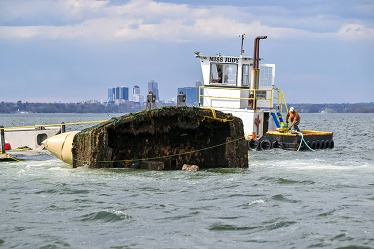
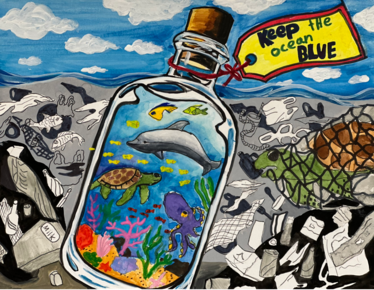
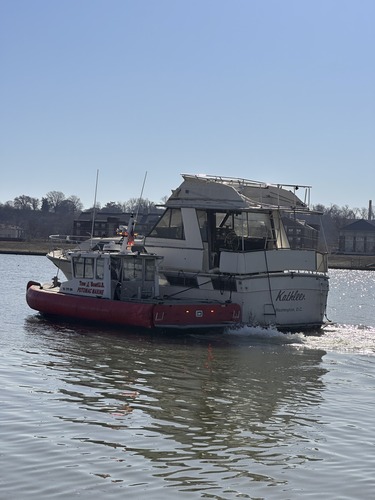
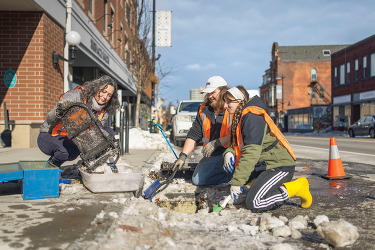
| Contractors remove a 55-foot sunken yacht near Hart Island, Bronx (Photo Credit: Daniel Avila, New York City Department of Parks and Recreation). The National Oceanic and Atmospheric Administration (NOAA) Marine Debris Program is pleased to announce 13 new projects awarded for funding under our NOAA Marine Debris Removal and Interception Technologies award competitions. These projects represent an investment in over $26.4 million for marine debris removal. The projects awarded under these nationwide competitive funding opportunities continue the NOAA Marine Debris Program's commitment to benefit the American economy, local communities, and coastal and marine habitats across the nation. Learn more about this year's recommended projects. Divers utilize lift bags to extract ghost traps otherwise inaccessible from the surface (Photo Credit: National Marine Sanctuary Foundation). The William and Mary's Batten School and the Virginia Institute of Marine Science (VIMS), in partnership with the NOAA Marine Debris Program, announced 13 new marine debris removal projects under the Nationwide Trap Removal, Assessment, and Prevention (TRAP) Program. These projects represent an investment of over $1.8 million for removal of derelict fishing traps with funds provided by the NOAA Marine Debris Program. The projects will remove derelict traps in California, Florida, Maine, Maryland, Massachusetts, New Jersey, Rhode Island, South Carolina, and Washington. Learn about the projects. Artwork by Aaron M. (Grade 8, Virginia), winner of the 2025 NOAA Marine Debris Program Art Contest. We are pleased to announce the winners of the NOAA Marine Debris Program Art Contest! We received many colorful, creative, and informative entries from around the country, and although we wish we could showcase them all, we are excited to share the winners of this year's contest with you. The winning artwork will be featured in a 2026 calendar, which will help to remind us every day of the importance of being responsible stewards of the ocean. Thank you to all the students and schools that participated in this year's contest! Check out all of the winning artwork on our website. A derelict vessel removed from Squaxin Island Tribes' Squaxin Island, carried over Budd Inlet in Olympia, Washington (Photo Credit: Washington State Department of Natural Resources). Washington State Department of Natural Resources Derelict Vessel Removal Program, with support from the NOAA Marine Debris Program and in partnership with the Squaxin Island Tribe and the Port of Olympia, airlifted 14 abandoned vessels via helicopter from the shoreline of Squaxin Island in Washington's Puget Sound. Washed up boats damage the shoreline and sensitive island habitats, creating navigational and safety hazards and hindering important Tribal activities. The Washington State Department of Natural Resources deployed their wildfire aviation team and helicopters to fly the boats from the island to the mainland for recycling and disposal. Learn more about these vessel removals. Caption: The Kathleen is being towed on the hip in this photo of her removal from the marina (Photo Credit: Anacostia Riverkeeper). Communities around Washington, D.C. are working to improve navigation and habitat in the Anacostia River by removing abandoned and derelict vessels. Thanks to funding from the NOAA Marine Debris Program, the Metropolitan Washington Council of Governments and the Anacostia Riverkeeper are working to remove 28 vessels over four years. They've already removed 13 vessels in just the first six months! Learn more about how this project benefits the community. The team at the Rochester Institute of Technology collects trash caught by an interception device placed in a storm drain in Rochester, New York (Photo Credit: Traci Westcott, RIT). With support from the NOAA Marine Debris Program, the Rochester Institute of Technology is partnering with Monroe County, New York to install litter catchment devices in storm drains across Rochester, New York. These devices act as strainers that capture debris before it can flow downstream, where it clogs stormwater pipes, creates safety hazards, and pollutes local waterways. Partners are using computer models and community input to gather information about litter hotspots and then strategically placing 50 of these devices across the city. Learn more about how this project improves water quality. | 
 VHAVENDA I.T SOLUTIONS









0 Comments
VHAVENDA IT SOLUTIONS AND SERVICES WOULD LIKE TO HEAR FROM YOU🫵🏼🫵🏼🫵🏼🫵🏼