Box of Amazing: Commentary and curation on our technology-driven society. Did your amazing friend send you this email? You can sign up at boxofamazing.com - it’s free! Now accepting keynotes for Q4 2025 / Q1 2026The SuperSkills Era: a 60-minute session for leadership teams, a practical framework on building human capability that thrives alongside AI. Research-backed. Immediately actionable. In person or virtual. UK, Europe, global. → Book a discovery call | → Explore: thesuperskills.com In addition to this newsletter, I recommend a few others. All free. Check them out here.
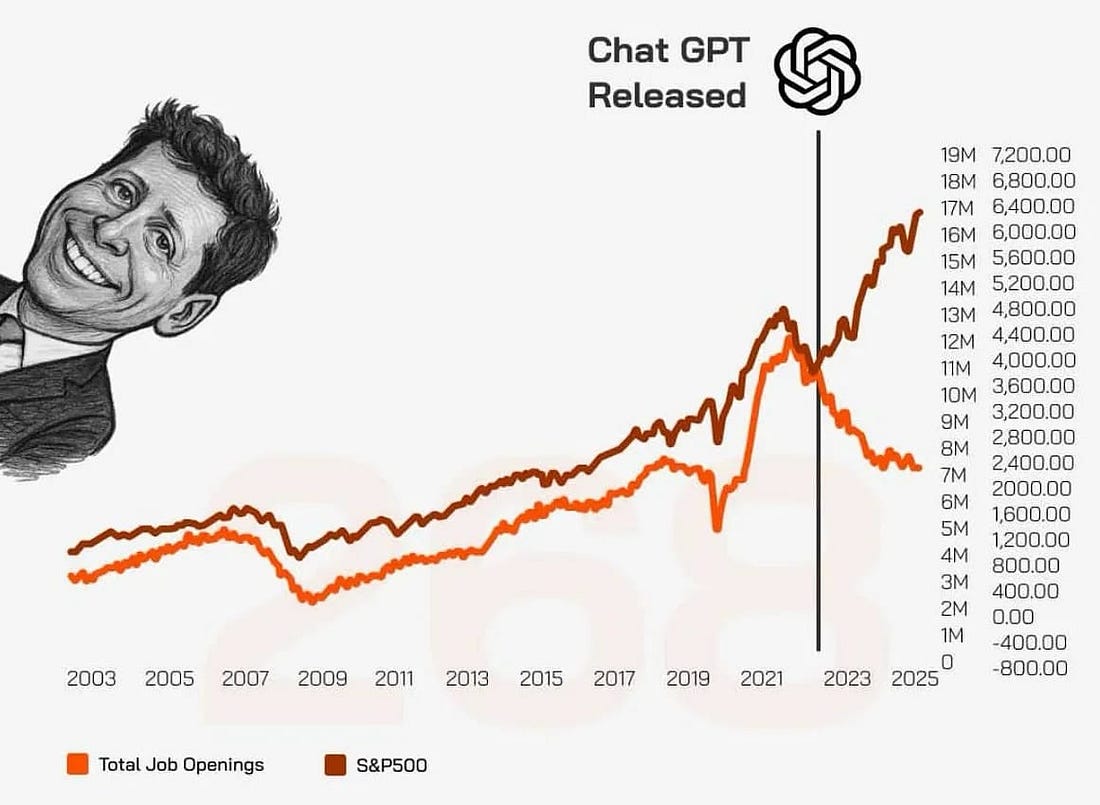
Friends, When Amazon announced that it was cutting 14k corporate employees last week, the headlines came thick and fast. Commentators called it a turning point. Some saw another wave of ordinary layoffs. Others said it was the dawn of a new era where machines had begun to eat the world of work. I had that WhatsApp, from one of my recent acquaintances - “Is this another sign of the AI apocalypse?” He had previously told me quietly that his biggest fear for his company and team was not automation but irrelevance. The truth sits somewhere between those two extremes. The language in these types of announcements are careful: efficiency, transformation, focus. In media, the language is stark: automation, disruption, apocalypse. Between those two interpretations lies a deep confusion about what was actually happening to employment itself. And then you see charts like this one:
The data is US centric, but wherever you are, it seeds panic and maybe confusion about your job. That confusion became the seed for this essay. For the last two years or so, while researching my forthcoming book, SuperSkills, I have spoken with more than 200 companies about how they are reorganising themselves. Technology firms, banks, media houses, logistics networks, universities, government, economists, research houses, and design studios. Each of them is wrestling with the same invisible phenomenon: the reengineering of human work. By 2030, the question will no longer be whether automation replaces jobs. The question will be what humans choose to become once intelligence is abundant. The real north star of this decade is not efficiency, but meaning. No one talks about that because they are in a panic for now. The conversation has often started with fear and ended with surprise. Few leaders believe they are replacing their people outright. What they describe instead is a vast rearrangement, a sort of Jenga-esque 3D jigsaw puzzle: tasks are absorbed by machines, decisions are pulled upward into data platforms, hierarchies are flattened, and whole disciplines are compressed into a single role. To understand the story, we need to examine it in its entirety. Forty distinct mechanisms of change, each playing out at different speeds, often within the same organisation. There are probably more; I’m no doubt overstating some, and some are what I see as the signal. I’m sure someone had done some diligence in this area. I just haven’t seen it. Automation – When the System Takes the Seat (1–5)The most visible transformation began with outright substitution. Klarna introduced automated customer support that now resolves two-thirds of all queries without human intervention (1). Duolingo used content-generation software to produce lessons in days that once took months (2). Law firms from New York to Berlin have adopted document-review programs that perform in an hour what used to occupy junior associates for a week (3). Some companies went further by forecasting automation before it arrived. IBM paused hiring for almost eight thousand back-office positions after modelling that those tasks would soon be absorbed by digital platforms (4). Within many large corporations, layers of middle management have thinned as dashboards and analytics now perform oversight functions that once justified entire divisions (5). Once the machines began to replace tasks, a new logic followed: productivity became the reason for reduction.
Efficiency and Rationalisation – Productivity as the New Redundancy (6–10)When Mark Zuckerberg declared 2023 the Year of Efficiency, Meta’s output per engineer rose by more than a third (6). One coder armed with digital assistants could now deliver the work of several. Across the industry, efficiency became the new redundancy. Other organisations found a convenient storyline. After the pandemic expansion, Amazon, Shopify and Zoom all began to shrink. The message was transformation. The motive was cost (7). Budgets themselves started moving. BuzzFeed closed its newsroom and redirected the funds to content-generation projects. Barclays diverted marketing budgets into computing contracts (8). People disappeared not to algorithms but to accounting. Several start-ups that had grown rapidly on early enthusiasm discovered that their economics no longer worked. Stability AI, Jasper and others reduced teams to stay solvent (9). The next group of firms followed a pattern of pre-emptive restructuring. Boards anxious to prove foresight began cutting before they had even implemented new technology (10). By 2025, even as unemployment stayed below four per cent in major economies, capital began to move faster than labour could follow.
Economic and Structural Reallocation – When Capital Moves Faster Than Labour (11–15)In 2024, large corporations spent more than £ 100 billion on intelligent-system infrastructure. The new investment acted as a vacuum for resources, pulling money from divisions across the enterprise (11). Even traditional downturns were repackaged as transformation stories. When market growth slowed or interest rates rose, the resulting redundancies were attributed to automation, rather than macroeconomic factors (12). Additionally, a correction emerged in firms that had expanded during the lockdown. Shopify, Salesforce and Zoom all returned to near-pre-pandemic staffing while announcing that they were embracing digital productivity (13). Some investments failed. IBM sold its Watson Health division, and dozens of start-ups in the generative-tool boom shut down within months of funding rounds (14). The ripple extended outward through supply chains. Automation compressed whole creative ecosystems. A single software platform could now generate the equivalent of an agency’s production work, eliminating editors, photographers and voice actors in one sweep (15). Gartner estimates that 63% of enterprises now embed generative tools in their workflows, a threshold that marks the shift from experimentation to infrastructure. In the UK, the Office for National Statistics recorded a 7X rise in vacancies for data governance and automation oversight roles since 2021, while manufacturing regions from the Midlands to the North East are retraining supervisors for predictive maintenance systems. By mid-2023, this acceleration had begun to feel unstoppable.
Expertise Collapse – When Knowledge Becomes Weightless (16–20)In May 2023, the education company Chegg lost almost half its market value in a single day when students discovered that automated tutoring programmes could provide answers for free (16). People quote the collapse and the chart that showed it for months. Stack Overflow’s web traffic fell for similar reasons. Inside the consultancy world, large firms noticed the same erosion from the opposite side. Clients were no longer paying for junior analysts when they could query data directly. McKinsey and Deloitte began redesigning their pyramids, reducing entry-level positions and adding new layers of digital oversight (17). Tools once reserved for experts became accessible to everyone. Canva and Adobe Firefly placed design and image manipulation in the hands of generalists, flattening the middle tier of creative work (18). Getty Images reported falling revenue as customers generated their own visuals rather than licensing stock photography (19). Inside most firms, the most painful losses came from hesitation rather than automation. Publishers and regional media outlets that waited to adapt found their audiences drifting to those that had experimented earlier (20). Behind the headlines, something stranger was forming: the collapse of boundaries within the job itself.
Social and Cascade Effects – When the Shock Spreads Beyond the Origin (21–30)The layoffs of 2023 created a displacement wave. More than 300,000 skilled professionals have left large technology firms. Many re-entered the market at smaller companies, accepting mid-level positions. This pushed existing staff downward and slowed promotion cycles (21). Experienced specialists began taking functions below their previous seniority, creating a kind of professional inversion that trapped younger employees at the bottom of the ladder (22). The oversupply of skilled workers began to depress wages in major cities, with software salaries falling for the first time in a decade (23). Inside organisations, external hires filled nearly every available opening, locking internal staff in place (24). At the same time, corporations relocated entire operations offshore. BT’s reductions in the UK were matched by new hiring in India under the label of transformation (25). Perception changed as well. Applications to journalism and design programmes dropped as students sought safer paths (26). Executives eager to appear decisive announced structural changes before their benefits were clear (27). Many of those announcements combined multiple motives: financial pressure, reorganisation and technology, wrapped together for simplicity (28). In countless offices, the hum of open-plan spaces now half empty, employees continued to hold job titles whose meaning had vanished. Managers monitored dashboards rather than teams, maintaining an illusion of authority while the actual work was being done elsewhere (29). Earlier this year I spoke to “Laura”, a mid-thirties project coordinator for an energy company who now manages five times the workload she once did. Her team was reduced from eight to two, yet the company still expect the same targets. “I finish work but it’s never finished,” she said. A small number of companies found more constructive approaches. Several banks retrained compliance officers to serve as ethics reviewers for automated decision-making programs. Telecom operators converted call-centre staff into digital-conversation trainers. They demonstrated that transitions could be humane if designed deliberately (30). Beneath these cascades of redundancy, the nature of a single job was also changing.
Compression – The Five-into-One JobAccording to my sources in some scale-up businesses in Europe and North America, the modern product manager now carries the weight of five former functions. Planning, design, testing, coding and release once sat across a team. Product managers in global technology now handle workflows once divided among five specialists, cutting project timelines by nearly sixty per cent. Screens glow through the night as timelines compress and fatigue rises. In retail, an e-commerce director now manages campaigns, writes copy, analyses data and coordinates logistics alone. The economic gain is clear. The psychological cost is intensity. The future of work is wider for each person, but thinner in depth.
The Token EconomyIntelligence itself has become measurable. Corporations now track the number of units of language or data they process. McKinsey recently passed one hundred billion tokens used within its internal knowledge networks, roughly equivalent to analysing every English-language document published in the last century. Across sectors, companies now track their own consumption of machine reasoning as if it were energy use, measured, billable and limitless. Firms celebrate those numbers as evidence of productivity. Yet what they reveal is stranger. Knowledge has become a utility, infinitely reproducible and available to all. Only discernment still resists measurement. Those numbers tell a deeper story, a story about attention, capability and what happens when intelligence becomes infinite but wisdom does not.
Augmentation and Creation – When Work Expands Again (31–40)Alongside the losses, a different surge is forming. The world is building new work even as it dismantles the old. Across every major economy, functions exposed to automation are evolving at twice the rate of others. Training cycles that once took years now take months. This phenomenon is known as skill acceleration (31). Siemens in Germany has retrained over thirty thousand staff through its in-house “AI Academy,” and Tata Consultancy Services in India has reskilled six hundred thousand engineers in under a year. Those who adapt are being rewarded. Employees fluent in digital productivity platforms earn, on average, fifty-six per cent more than their peers (32). PwC’s UK wage analysis shows the same pattern. In South Korea, Samsung offers salary increases for those certified in generative technology integration. Higher efficiency is also creating room for expansion. Walmart in the United States and Carrefour in France both added thousands of logistics and operations jobs after implementing predictive scheduling, which cut waste by nearly a fifth (33). In India, Reliance Retail expanded its distribution workforce to support the rollout of warehouse automation. New functions are emerging fastest in data-rich sectors. Ping An Insurance in China employs twenty-five thousand hybrid analysts who combine financial modelling with data-science oversight. At the same time, AXA in France has built a new unit of “algorithmic risk managers”. This sector surge (34) shows how human judgement and computation now coexist at scale. Entire ecosystems are forming around governance and quality. DeepMind has established dedicated teams for safety research, and NTT Data in Japan operates bias-audit units across its client projects. Thousands of data curators and model evaluators now work across Europe, the US and Asia. These ecosystem jobs (35) are expanding faster than most professional services. Even industries built on physical labour are changing. Komatsu in Japan utilises vision monitoring to reduce mine accidents, and Tata Steel has installed predictive safety systems across its Indian plants. ABB in Switzerland trains on-site robotics engineers to maintain these platforms. This augmentation of deskless workers (36) is one of the least discussed but most promising aspects of the transformation. Freelancers and small business owners are also discovering the benefits of leveraging their resources. Independent creators, using tools such as Runway and ElevenLabs, now produce professional-grade media directly from their laptops. A marketing consultant from Mumbai told me she manages six clients with the help of digital assistants “a one-woman agency,” she laughed. This super-agency empowerment (37) is rewriting entrepreneurship. Geography is shifting too. Economic gravity is moving from established capitals to new centres. Bangalore now hosts more than 1.2 million digital contractors, while Warsaw has become a European hub for automation start-ups. In Vietnam, Ho Chi Minh City is exporting back-office services for global finance. This job reallocation (38) is visible in nearly every employment dataset. Education and training have become growth industries. The National University of Singapore now includes “AI Literacy” modules across all degrees, while OpenClassrooms in France has introduced certified prompt-engineering courses. Universities, online academies and corporate trainers are racing to supply this demand for core literacy (39). The most intriguing development lies in the rise of hybrid professions. Editors at the BBC refine automated transcripts. Volkswagen employs algorithmic-compliance officers. Mitsubishi UFJ in Japan has established an ethics oversight department for decision-making programs. These human–system symbiosis positions (40) demonstrate that partnership, not substitution, defines the next phase of work.
The Numbers That Explain the MomentEvery statistic now carries a moral weight, because each number hides a life rearranged. The World Economic Forum estimates that by 2030, around ninety-two million roles worldwide will have been displaced by automation while one hundred and seventy million new ones will emerge. The net effect is a gain of roughly seventy-eight million positions. The friction lies in timing. The latest jobs do not appear where or when the old ones vanish. Skills are evolving sixty-six per cent faster in exposed sectors than in others, and productivity in technology-heavy industries is tripling revenue per employee. IDC forecasts that Asia-Pacific investment in automation will reach $120 billion by 2027, overtaking the combined investment of the United States and Europe. The EU’s Digital Decade targets eighty per cent digital literacy across the workforce by 2030, creating twenty million specialised roles. The numbers suggest a paradox: the faster the world learns, the more learning it demands. The Actual TruthAcross every study, the same thing is happening. Digital platforms now touch two-thirds of all work tasks in developed economies, yet fewer than five per cent of jobs can be fully automated. The shift is about redefinition. The most profound consequence is the loss of certainty. For more than a century, a job was a box that contained a set of tasks, a title and a predictable path. That box is gone. What remains is fluid work, guided by judgement, creativity and continuous learning. The Human ReckoningDuring my conversations with these companies over the last two years, no one claimed to have a complete map of what lies ahead. No one. Each was experimenting, adjusting structures in real time. The same sentence echoed across industries: every organisation has access to the same tools; what matters is how people think with them. That’s the difference. Human skills. Intelligence has become a public good, yet every conversation with leaders ends in the same place: the tools converge while people diverge. This is the central premise of SuperSkills. The future depends less on the mastery of systems and more on the depth of qualities that remain human: curiosity, empathy, discernment and integrity. The next decade will reward those who combine these attributes with a precise understanding of their platforms. Knowledge is no longer power. Wisdom is rare. The Global Map of TransformationThe geography of this transformation is uneven. In Asia, the shift is industrial, visible on factory floors and logistics hubs. Japan, India and China have made intelligent automation part of their national strategy, linking productivity with employment through massive reskilling. In Europe, the focus is on governance: France, Germany, and the Nordics are creating tens of thousands of roles in ethics, compliance, and sustainability. The United States continues to lead in experimentation, but its volatility creates sharper social shock. Europe moves more slowly, yet steadier. Asia scales faster, though its growth clusters around its great cities. And places like Dubai in the UAE are pushing in ways that are revolutionary. Together, these regions describe one shared arc, which is the redistribution of intelligence. The tools travel freely; the outcomes depend on how societies adopt and utilise them. (please note. I struggled with getting reliable data from Asia.) The New North StarWork is being rebuilt in forty directions at once. The old boundaries between thinking and doing, between leadership and craft, are dissolving. Teams are becoming platforms. Careers are becoming experiments. The organisations that will prosper are those that design around human potential, using technology as a scaffold rather than a substitute. The individuals who will prosper are those who view learning as a lifelong pursuit. A single region no longer dominates the new economy. It is co-created by the boldness of America, the discipline of Europe and the scale of Asia. The true story of this so-called apocalypse is not one of destruction but of transformation. Work is being remade by human choice as much as by code. The only question left is whether we drift into the future the algorithms build for us, or design the one we want to inhabit. Stay Curious - and don’t forget to be amazing,
Tools I Use:
 Recommend Reading:Now
Next
If you enjoyed this edition of Box of Amazing, please forward it to a friend or share the link on WhatsApp or LinkedIn. Box of Amazing is a weekly digest curated by Rahim covering knowledge, society, emerging technology, trends and extraordinary articles, hand-picked to broaden your mind and challenge your thinking.
|
The True Story of the AI Apocalypse






Posted by WE BRING YOU THE BEST!
 VHAVENDA I.T SOLUTIONS


0 Comments
VHAVENDA IT SOLUTIONS AND SERVICES WOULD LIKE TO HEAR FROM YOU🫵🏼🫵🏼🫵🏼🫵🏼