| Stay updated with today's top AI news, papers, and repos.  | | Hey James | Welcome to AlphaSignal, the most read source of news by AI engineers and researchers.
Every day, we identify and summarize the top 1% of news, papers, models, and repos, so you're always up to date.
Here's today's roundup: | | Top News | | | | Google launches Gemini 3, improving long-context reasoning, tool workflows, and multimodal accuracy | | 42,485 Likes | 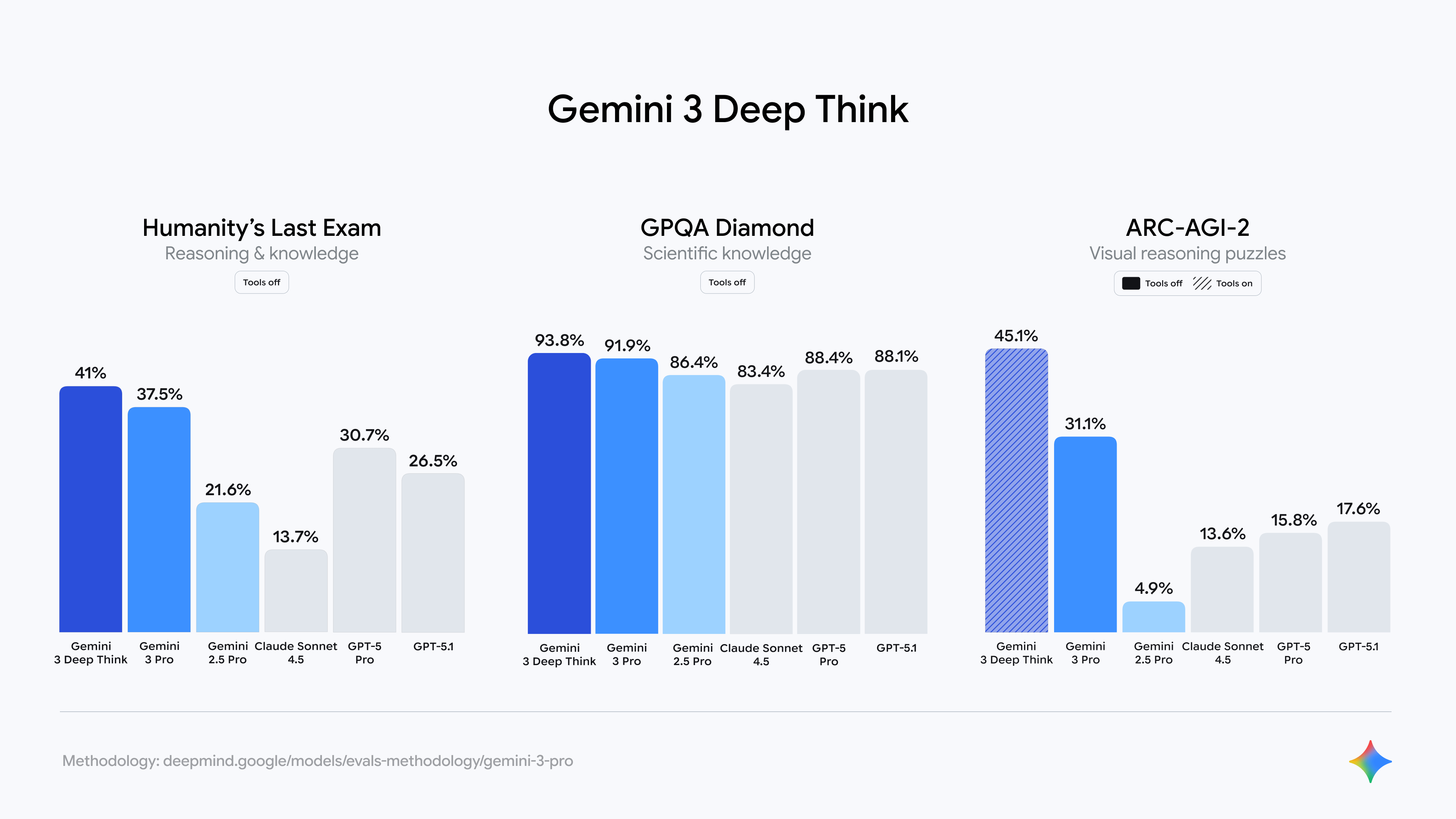 | | Google introduced Gemini 3 and set a new bar for frontier models. The headline result is 1501 Elo on LMArena, the highest public rating for structured reasoning. You can use the model now in AI Studio, Vertex AI, the Gemini CLI, and Antigravity. A Setup: Need for better deeper reasoning For all the rapid upgrades in the last two years, developers hit the same pain point: models reason well sometimes and fail oddly on tasks humans find straightforward. Long prompts drift, tool usage breaks mid-workflow, and multimodal tasks behave inconsistently. The Problem: Models don't think far enough ahead Most models still collapse under long chains of decisions. Terminal workflows stall. Large documents exceed context limits. Multimodal tasks require stitching several tools together, which slows development and introduces errors. The Insight: Improve raw reasoning, expand context, and stabilize tool use Gemini 3 focuses on reasoning depth and consistent planning. Google pushes model internals to analyze information more systematically, handle long contexts, and execute multi-step actions without drifting. The Breakthrough: Gemini 3 raises benchmark scores across all core dimensions Key results -
1501 Elo on LMArena for structured reasoning -
37.5% on Humanity's Last Exam without tool use -
91.9% on GPQA Diamond for scientific reasoning -
87.6% on Video-MMMU for multi-frame analysis -
72.1% on SimpleQA Verified for factual accuracy -
54.2% on Terminal-Bench 2.0 for tool-controlled workflows -
76.2% on SWE-bench Verified for codebase reasoning The Impact: Developers get more reliable agents and richer multimodal workflows Gemini 3 handles full-year planning on Vending-Bench 2 and keeps decisions coherent. You can run browser flows, operate terminals, analyze video frames, or process large research papers in one session. How to use it -
Select Gemini 3 Pro in AI Studio or Vertex AI -
Run multimodal prompts in the Gemini CLI -
Use Antigravity to execute agent-driven tasks inside an AI-aware IDE Additional Gemini 3 variants will follow after the Pro preview. | | | | Compare Al Inference Systems' Performance with the Token Economics Calculator | | Sponsored |  | | Tensordyne develops AI inference chips and systems powered by logarithmic math. The company developed the Token Economics Calculator, a tool that compares AI inference system performance across key metrics with consistent and normalized scenarios. What you'll get: -
Scenario-normalized benchmarks for consistent evaluation -
Capacity modeling for target users and KV-cache -
Cost and power metrics: tokens per dollar and tokens per kWh -
Architecture trade-offs across SRAM-only and HBM systems Data comes from publicly available sources and is user modifiable. | | | | partner with us | | Explore the AI Tech Stack Map for Modern Data Pipelines AI teams transform petabytes of raw data into high-quality training data, but the workflow is far more complex than just adding compute. Encord's interactive map shows where leading teams invest in annotation, curation, and evaluation to close the AI data gap.
See how data moves, where bottlenecks form, and which workflows matter most for model quality. | | | Trending Tutorials | | | | Google's guide for Gemini 3 shows new reasoning controls 1,394 Likes Google's new Gemini 3 Developer Guide details advanced parameters like thinking_level, media_resolution, and Thought Signatures. It explains structured outputs, migration from 2.5, and new controls for latency, multimodal precision, and reasoning depth across API SDKs. | | | | | | | | | Coding Tip | | | | Speed Up JSON Debugging with jq Commands | Use jq to debug and reshape JSON directly in your terminal. It helps you inspect model outputs, API responses, and agent traces without writing throwaway Python scripts.
How to use it:
Run jq '.field.nested'
to extract values.
Run jq 'keys'
to inspect structure.
Why use it?
It gives you fast, scriptable JSON queries, makes logs readable, and saves time when working with large LLM or agent responses. | | | At Alpha Signal, our mission is to build a sharp, engaged community focused on AI, machine learning, and cutting-edge language models, helping over 200,000 developers stay informed and ahead. We're passionate about curating the best in AI, from top research and trending technical blogs to expert insights and tailored job opportunities. We keep you connected to the breakthroughs and discussions that matter, so you can stay in the loop without endless searching. We also work closely with partners who value the future of AI, including employers and advertisers who want to reach an audience as passionate about AI as we are.
Our partnerships are based on shared values of ethics, responsibility, and a commitment to building a better world through technology.Privacy is a priority at Alpha Signal. Our Privacy Policy clearly explains how we collect, store, and use your personal and non-personal information. By using our website, you accept these terms, which you can review on our website. This policy applies across all Alpha Signal pages, outlining your rights and how to contact us if you want to adjust the use of your information. We're based in the United States. By using our site, you agree to be governed by U.S. laws. | | | Looking to promote your company, product, service, or event to 250,000+ AI developers? | | | | |

 VHAVENDA I.T SOLUTIONS


0 Comments
VHAVENDA IT SOLUTIONS AND SERVICES WOULD LIKE TO HEAR FROM YOU🫵🏼🫵🏼🫵🏼🫵🏼